
10 Unique Networking Games for New Student Engagement
You’ve got hundreds of nervous freshmen coming together at your upcoming event. Here’s how to get them talking and interacting with each other.
10 Networking Games for Your New Student Orientation & Welcome Events
Duration
Group size
Showing 10 of 10 games
Dorm Room Bingo
How to play
- 1
Create bingo cards with prompts like 'Someone who brought a plant,' 'Someone who has a roommate from another state,' 'Someone who already decorated their side,' 'Someone who forgot something important at home.'
- 2
Give everyone a card as they arrive at the residence hall meeting or orientation session.
- 3
Students have 15 minutes to walk around and find someone who matches each square. When they find a match, that person signs their square.
- 4
First person to get a full row (or full card) shouts 'Welcome Home!' and wins a small prize.
- 5
After someone wins, keep going for 5 more minutes so everyone gets at least a few signatures.
- 6
Debrief: 'Who found someone with the same weird dorm item as you?'
This takes the pressure off the first 'hello' because students have a mission. The prompts are intentionally specific — 'someone who packed more shoes than clothes' always gets a laugh.
First person to complete a full row or full card wins.
A campus bookstore gift card, a Ramen noodle care package, or a 'First Friend' lanyard.
The card gives them a script. They can just hold up their card and point — no clever opening line needed. And they can work in pairs if that feels safer.
Two Truths, One Dorm (Residence Hall Edition)
How to play
- 1
Gather students in small circles of 6–8 (by floor or wing of the dorm).
- 2
Each person shares two true statements about themselves and one lie — but the twist: all three must relate to living away from home for the first time. Examples: 'I've already cried twice today' (true), 'I brought 14 pairs of shoes' (true/lie), 'I know how to do my own laundry' (could go either way).
- 3
The group votes by pointing at the person (thumb up for statement 1, middle for 2, pinky for 3). On the count of three, everyone points.
- 4
The person reveals the lie. Whoever guessed correctly gets a point. The person who shared also gets a point just for being brave.
- 5
Rotate around the circle until everyone has gone once.
- 6
The person with the most points at the end wins a 'Professional Liar Detector' title for the floor.
The 'living away from home' constraint makes this perfect for move-in weekend. Someone's lie is always hilarious — 'I packed my entire closet' when their roommate saw they brought three shirts. The pointing mechanic is silly and low-stakes.
Person who correctly guessed the most lies across all rounds wins.
A pack of instant noodles, a 'Floor Detective' badge, or first pick of the communal microwave time slot.
Quiet students can go last, which means they've heard a bunch of examples first. They can also pass and just be the scorekeeper — still participating without sharing.
Jam Bingo - 100 Person Ice Breaker Activity
How to play
- 1
Help new students make their first friends, so they feel like they belong on campus from the first week.
- 2
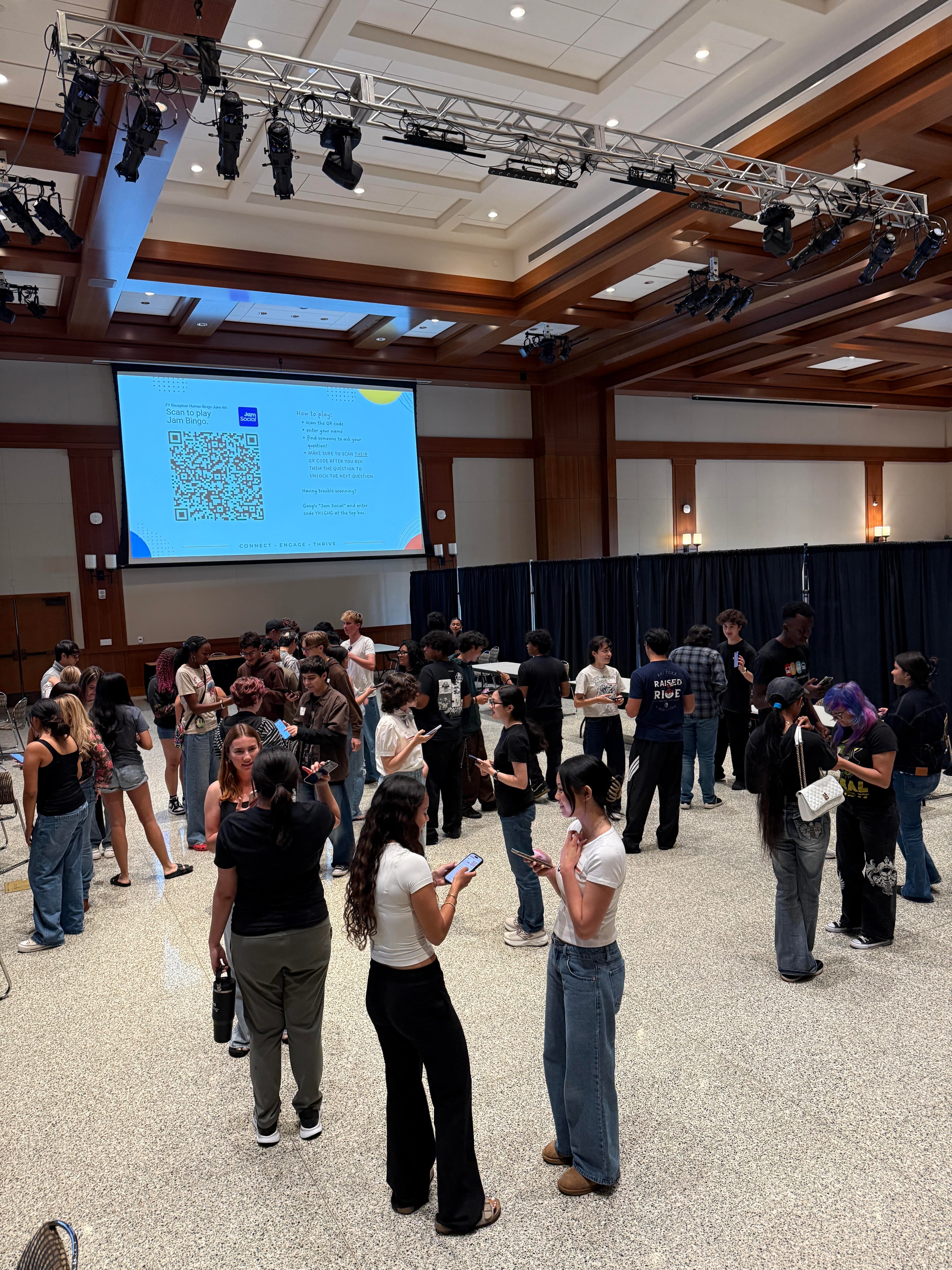
At your orientation or welcome event, display the QR code on the main screen, print it on the event program, or put it on every table. Ask students to scan with their phone camera as they walk in.
- 3
Each student receives a series of conversation challenges and prompts tailored to new student life — things like 'Find someone who has the same major as you,' 'Find someone who also forgot to bring an umbrella,' 'Find someone who is the first in their family to go to college,' or 'Find someone who is also nervous about cafeteria food.'
- 4
Students walk around the room, approach people they haven't met yet, and have a real conversation to complete each challenge. Completing a challenge unlocks the next prompt.
- 5
The app guides everything — no paper cards, no manual tracking. Everyone just scans, talks, and connects naturally.
- 6
The first person to complete all their challenges wins a prize. But the real goal is to make sure by the end of 30 minutes, every new student has talked to at least five people they didn't know when they walked in.
- 7
Before the event, set up your College Icebreaker Bingo game. Mix academic prompts ('Find someone in the same intro class'), personal prompts ('Find someone who also misses their pet'), and fun ones ('Find someone who can do an impression of their RA').
- 1
How is Jam Bingo Played?
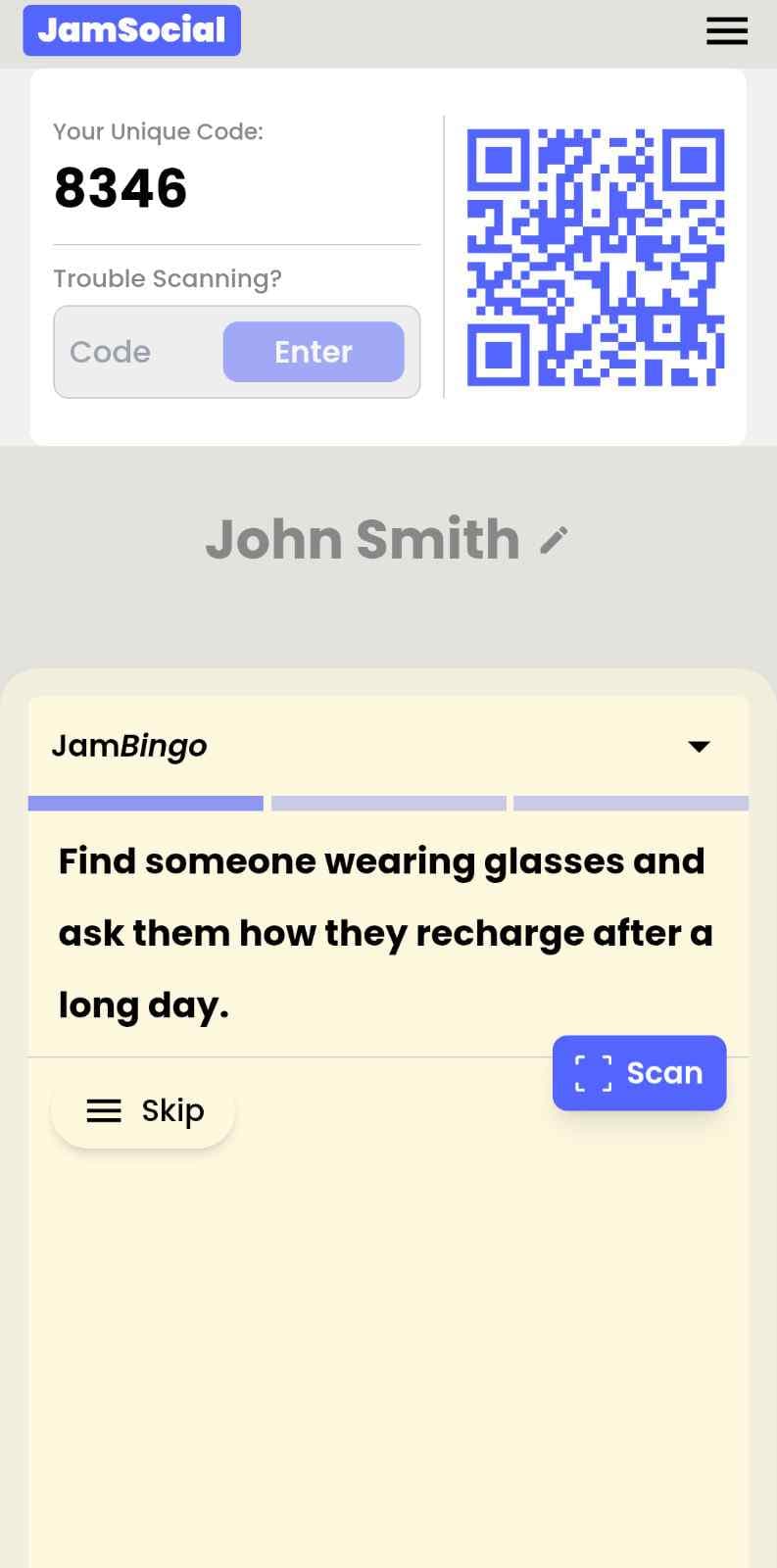
Attendees scan the event’s Jam Bingo QR code (or enter the game code). It runs in the phone’s browser—there is no app to download.
- 2
Conversation Starter
Each person receives a conversation prompt on their phone, like a question to ask someone new.
- 3
Find someone and talk
They find someone who fits the prompt, have the conversation, then scan that person’s QR code (or enter their code) to unlock the next prompt.
- 4
Repeat and connect
Every connection is saved, and the leaderboard shows who met the most new people—perfect for prizes.
This is the 100 person ice breaker activity that actually works for large groups. The magic is that it gives every student a reason to approach someone else — no awkward 'so... what's your major?' with no follow-up. The app does all the logistics for you. Just show the QR code and watch the room transform from frozen to buzzing.
Everyone who completes all their challenges. First to finish gets a grand prize.
Grand prize: A $50 campus bookstore gift card or a dorm room starter kit (mini fridge, microwave, snack basket). Every finisher: A 'Connected' digital badge and a shoutout in the residence hall group chat.
The app gives introverts a perfect script: 'Hey, my app says I need to find someone who...' It removes the 'what do I even say?' panic. Plus, they can move at their own pace, one-on-one, without any whole-room spotlight.
Human Syllabus (The Line Game)
How to play
- 1
Create a long line on the floor with tape or chalk. One end is 'Strongly Agree,' the other is 'Strongly Disagree.'
- 2
Read statements one at a time: 'Pineapple belongs on pizza.' 'I am a morning person.' 'I'm nervous about making friends.' 'I already know what I want to major in.' 'I will definitely join a club this semester.' 'I miss my pet more than my parents.'
- 3
After each statement, students physically stand on the line where they belong.
- 4
Once everyone is standing on their spot, say: 'Turn to the person closest to you. Ask them why they're standing there.' Give them 60 seconds to talk.
- 5
Then read the next statement. Everyone moves again.
- 6
After 8–10 statements, ask: 'Who changed their position based on a conversation?' Hands go up. Those students win a small prize.
This game gets students moving and talking without the pressure of a formal 'introduction.' The physical act of choosing a spot on the line is more honest than raising a hand. The one-on-one conversations are where real connection happens.
Anyone who changed their position during the game wins a small prize — but honestly everyone wins by moving.
A 'Flexible Thinker' sticker, a snack from the RA's stash, or a coupon to the campus coffee shop.
They can stand on the line without speaking at all. The 'turn to your neighbor' conversation is just two people, not the whole room. And they can just listen if they're not ready to share.
Floor Plan Friends (Draw Your Dorm)
How to play
- 1
Tape a giant piece of paper to the wall (or use a whiteboard). Draw a rough outline of the residence hall floor plan — just room numbers or general areas.
- 2
Give each student a marker. One by one, they come up and draw something on the floor plan that represents them: 'I'm in room 204, and I brought this plant.' 'I'm at the end of the hall, and I'm the one who plays guitar.' 'I'm on the third floor, and I'm terrified of the elevator.'
- 3
As each person draws, they say one sentence about what they're adding. No pressure for a speech — just 'I'm Sarah, room 204, plant lady.'
- 4
After everyone has drawn, the RA leads a 'gallery walk' — everyone walks slowly along the wall while the RA points out: 'Look at all the people near the lounge. Look at all the people who brought gaming consoles.'
- 5
The floor plan stays up for the first week as a visual reminder of who lives where.
This is inspired by community mapping projects used in student housing across Scandinavia. The physical drawing gives students something to do with their hands while introducing themselves — way less awkward than standing in a circle. And the final product is actually useful.
No winner — the floor plan itself is the win. Optional: 'Most Creative Drawing' voted by residents.
The floor plan gets laminated and hung in the common room. The 'Most Creative Drawing' winner gets a pack of markers.
They can draw without speaking much — just a 'room 204' and a quick sketch. The gallery walk requires no talking at all. And they can add to the plan later, alone, if the group setting feels like too much.
Sock Slide (The Great Hallway Race)
How to play
- 1
Clear a long hallway in the residence hall. Mark a start line with tape. Students remove their shoes — socks only.
- 2
Divide into teams by floor or wing. One person from each team stands at the start line.
- 3
On 'Go!', they take a running start and slide as far as they can on their socks. The person who slides the farthest without falling gets a point for their team.
- 4
Here's the twist: Before each person slides, they have to answer a question from the RA: 'What's one thing you want to do before finals?' or 'What's a class you're actually excited about?'
- 5
After they answer, they slide. The group cheers (or laughs).
- 6
The team with the most points after everyone has slid once wins the 'Golden Sock' trophy.
This is a classic dorm tradition in universities across the Midwest, but it works everywhere. The physical silliness breaks down walls instantly — it's hard to be cool when you're sliding down a hallway in socks. Keep the questions light and future-focused.
Team with the most total slide distance points wins.
A pair of 'Golden Socks' (spray-painted old socks), a pizza party for the winning floor, or first pick of the study lounge for a week.
Quiet students can be the official 'distance measurer' — an important job with no spotlight. Or they can slide without answering by pairing with a talkative teammate who answers for both of them.
Snack Exchange (The Great Dorm Trade)
How to play
- 1
Before the event, ask each student to bring a snack that represents where they're from (or give everyone a random snack as they arrive).
- 2
Everyone stands in a large circle, holding their snack.
- 3
The RA calls out a category: 'Trade with someone who has a pet.' Students with pets trade snacks with someone else who raised their hand.
- 4
Then: 'Trade with someone who is also a first-generation student.' Trade again.
- 5
Then: 'Trade with someone who has a different intended major than you.' Trade again.
- 6
After 5–6 trades, the RA says: 'Now eat your final snack with the person you're standing next to. Ask them: What's one thing you're nervous about this semester?'
- 7
Pairs have 5 minutes to eat and talk. Then the RA asks: 'Who wants to share something they learned about their snack partner?' A few hands go up.
The snack becomes a conversation piece — 'Wait, you brought Cheetos from Texas? They're different here?' The forced trades (you WILL trade, you WILL talk to someone new) remove the 'should I approach them?' hesitation. And everyone loves snacks.
No winner — but the person who learns the most surprising fact about their snack partner gets to take home any leftover snacks.
The leftover snack pile. That's the prize. Students will fight for it.
They can just hold their snack and trade without saying much. The one-question conversation at the end is just two people, not the whole room. And the snack is a built-in distraction — less pressure to perform.
Cafeteria Line Confessions
How to play
- 1
This works best during actual cafeteria lines, but you can simulate it by having everyone line up single file.
- 2
The RA stands at the front of the line with a microphone (or just a loud voice). As each person reaches the front, they must share a 'confession' — something true and funny about their first week. Examples: 'I accidentally walked into the wrong class and stayed for 20 minutes.' 'I cried because I couldn't figure out the laundry machines.' 'I've already lost my student ID twice.'
- 3
After sharing, they can move into the cafeteria (or to the next activity).
- 4
The group cheers and laughs at each confession — no judgment, just recognition that everyone is struggling a little.
- 5
The RA collects the best confessions and reads them at the end of the meal: 'See? Everyone is weird. You're fine.'
This is borrowed from a tradition at University of Oregon's freshman orientation. The line format means everyone has to go through — no hiding. But the 'confession' can be as small as 'I forgot my mom already called me three times' — no pressure to be hilarious. The shared vulnerability is the point.
No winner — but the person who makes the room laugh the hardest gets a free dessert (if you're in the cafeteria) or a 'Best Confession' button.
A free cookie or ice cream from the cafeteria, or a 'Survivor' sticker.
Their confession can be one word: 'Homesick.' 'Lost.' 'Tired.' That's enough. And if they really can't, they can pass with a 'I owe one' and the RA moves on — no shame.
Common Room Quest (Scavenger Hunt)
How to play
- 1
Create a scavenger hunt list of things to find and people to meet in the residence hall common areas. Examples: 'Find someone who can show you their favorite study spot.' 'Find a vending machine that has your favorite candy.' 'Find someone who lives on a different floor and ask them one thing about their RA.' 'Find the lounge's board game collection and take a photo with a game you've never played.'
- 2
Divide students into small teams of 3–4 (mix floors and buildings).
- 3
Teams have 20 minutes to complete as many items as possible. The rule: you must talk to at least one person you don't know for each item.
- 4
When time is up, teams return to the common room. The team with the most completed items wins.
- 5
Bonus round: 'What's the most interesting thing someone told you during the hunt?' Teams share one highlight.
This turns 'exploring the dorm' into a game. The 'talk to someone you don't know' rule forces interaction without making it weird — you have a mission, so the conversation has a purpose. The common room becomes familiar instead of intimidating.
Team with the most completed scavenger hunt items wins.
A board game for their floor's common room, a bag of popcorn for a movie night, or a 'Hall Explorers' trophy.
Small teams mean quieter voices have room. They can be the 'navigator' or 'list keeper' — roles with less talking. And the conversations are task-focused ('Can you show me the study spot?'), not open-ended small talk.
Move-In Memory (The First Day Story)
How to play
- 1
Gather students in a circle. The RA starts: 'On move-in day, the weirdest thing that happened to me was...' and shares a 30-second story.
- 2
Going around the circle, each person shares ONE thing that happened on move-in day. It can be funny, frustrating, or sweet. No length limit, but the group chants 'Next!' if someone goes over 30 seconds.
- 3
After everyone has shared, the RA asks: 'Who had the most chaotic move-in?' Applause vote.
- 4
Then: 'Who had the most heartwarming?' Applause vote.
- 5
Then: 'Who had the most embarrassing?' Applause vote (affectionately).
- 6
The winners get small prizes. But the real win is realizing everyone else had a weird day too.
This is the perfect 'first night in the dorm' activity. Move-in day is universally chaotic — sharing those stories bonds people immediately. The 30-second rule keeps it moving. The applause voting is silly and low-stakes.
Person who gets the most applause in each category wins. But really, the person who laughed the hardest at their own story wins everyone's respect.
A 'Most Chaotic' crown (paper), a box of tissues for 'Most Heartwarming,' or a 'We've All Been There' button for 'Most Embarrassing.'
Their story can be one sentence: 'My dad cried.' 'The elevator broke.' 'I forgot my pillow.' Short is fine. And they can pass entirely — the RA will come back to them after the circle, one-on-one.
How to Run Icebreakers for New Student Engagement (Without Freshmen Faking Sick to Get Out of It)
- 01
Start with the digital college bingo app — before anyone sits down
As students walk into the orientation session or residence hall meeting, have the QR code on the screen, on every chair, and on a sign at the door. The app gives them a reason to talk to strangers immediately — before they have time to grab their phones and hide. Run it for exactly 20 minutes, then transition to the next activity. You'll be amazed how quickly the room warms up.
- 02
Do physical games first, reflective games later
Start with Dorm Room Bingo or Sock Slide — get bodies moving. Nervous energy needs an outlet. After 30 minutes of movement, students are calmer and more open to reflective activities like Move-In Memory or The Line Game. Never start with a sharing circle. That's how you get 50 freshmen staring at their shoes.
- 03
Use RAs as game captains, not the main facilitator
Train your RAs on 2–3 games each. On event day, each RA runs a station. Students rotate every 15 minutes. This prevents bottlenecks, gives shy students a smaller group to engage with, and means no single person has to carry the whole event. RAs also get to know their residents through the games — that's the hidden win.
- 04
Make every game OPT-IN for the first 5 minutes
Announce: 'For the first 5 minutes, just watch. Then join when you're ready.' This lowers the barrier dramatically. The students who jump in first will be the natural extroverts. The ones who watch for 5 minutes will join once they see it's not scary. The ones who never join — that's fine too. They're still watching, still listening, still learning names.
- 05
End with Common Room Quest on night one
After all the structured icebreakers, send students on the scavenger hunt in small teams. This gives them a reason to explore their new home and keeps them together after the official programming ends. By the time the hunt is over, they'll have inside jokes with their team — that's the foundation of a friend group.
- 06
Post a visible 'Tonight's Flow' sign at the entrance
Print a simple poster: '7:00 PM — College Bingo (scan QR), 7:20 PM — Sock Slide (hallway), 7:40 PM — Snack Exchange (common room), 8:00 PM — Common Room Quest (scavenger hunt).' This removes anxiety for introverts who want to know what's coming. It also helps latecomers jump in mid-activity.
- 07
Have low-stakes prizes that everyone wants
Freshmen will do almost anything for: Ramen, cafeteria swipes, a free laundry card, a mini fan, string lights, a phone charger, or a snack basket. Avoid 'winner gets a certificate' — they don't care. Give them something they can use in their dorm room. The person who doesn't win still had fun, but the person who does win walks away with something tangible.
Frequently Asked Questions
How many icebreakers should we run during a 2-hour orientation session?
Run 3 icebreakers max, plus the digital college bingo at the start. A solid rhythm: College Bingo (20 min arrival), Dorm Room Bingo or Sock Slide (20 min), Snack Exchange (15 min), Common Room Quest (30 min). That's 85 minutes of structured activity, plus 35 minutes of transition and unstructured time. Don't over-program. The unstructured time is where real friendships start.
What if some students already know each other (roommates, high school friends)?
That's great — they'll help the others feel safe. Use the digital college bingo app to force mixing: the challenges should require talking to people outside your immediate group. For physical games like Sock Slide, assign teams randomly (count off 1-2-3-4). Don't let cliques form in the first hour. After hour one, let them sit with whoever they want — the damage is already done (in a good way).
How do we include students with disabilities or mobility challenges?
Every game here has a seated or stationary role. For Sock Slide, they can be the official measurer or cheerleader. For Common Room Quest, they can be the navigator or photographer. For The Line Game, they can sit and raise a colored card instead of standing. Ask beforehand: 'How would you like to participate?' Never assume. And make sure your RA training includes 'how to adapt on the fly.'
What if we have 200+ students and only one common room?
Break into sections by floor or by RA group. Run the digital college bingo app for everyone simultaneously — the app handles large groups easily. For physical games like Sock Slide, run it in shifts (floors 1-2 at 7 PM, floors 3-4 at 7:30 PM). For Common Room Quest, split into 10 small teams and stagger start times by 2 minutes. The key is having multiple RAs running multiple stations. One facilitator cannot handle 200 freshmen alone.
How do we handle students who really don't want to participate?
Respect it immediately. Never force. Instead, give them a visible 'opt-out' role: snack distributor, timekeeper, photographer, or music DJ. For the digital college bingo app, they can just answer challenges from their seat without walking around. Some of the best observers become the most engaged participants by week two — they were just watching and learning at first. Honor that.
Do we need to buy special equipment for these games?
Almost nothing. You need a QR code for the digital college bingo app (free with the link above), sticky notes, markers, snacks (students bring or RA provides cheap ones), and tape for the floor plan and start lines. For Sock Slide, you need a hallway and socks. That's it. The most expensive item is the prizes — and those can be Ramen packets and cafeteria swipes. New student engagement icebreakers should feel thrown-together, not over-produced.
More Networking Game Collections
10 Easy & No-Prep Interactive Networking Games for Professionals
Professional Networking Event · 10 games
11 First-Time Coming Together Networking Games for Corporate Events
First-Time Coming Together Corporate Event · 11 games
20 Networking Games for a Company Annual Partner Showcase
Company Partner Showcase · 20 games
25 Icebreakers for an Association AGM & Tradeshow Mixer
Association AGM & Tradeshow Mixer · 25 games
10 Team Ice Breaker Activities for Your Company Picnic
Company Picnic · 10 games
11 Church Anniversary Networking Games
Church Anniversary · 11 games