10 Company Annual Gathering Interactive Ice breaker Activities
Your annual gathering should feel like a celebration, not a compliance event. These icebreakers help people actually connect around the year that was — and get excited for what's next.

10 Networking Games for Your Company Annual Gathering
Duration
Group size
Showing 10 of 10 games
Kottabos (Wine & Wisdom Toss)
How to play
- 1
Fill cups with a few sips of drink. Place a small coin or bottle cap floating in each.
- 2
Players take turns trying to flick the cap out of the cup by tapping the side of the rim with their finger (or by flinging remaining drops of drink - tradition style).
- 3
If you sink the cap or knock it out, you must answer a 'Year End Question' (e.g., 'What is a risk that paid off this year?').
- 4
If you miss, you take a sip and share something you learned from a mistake.
- 5
Rotate players and continue for several rounds, mixing reflection with friendly competition.
- 6
End by having the group share one collective insight from the activity.
This ancient Greek game was played after dinner parties to show off fine motor skills while drunk. This sober version is perfect for reflecting on the 'hits and misses' of the fiscal year.
Most caps knocked out of cups.
A small olive branch (real or fake) or a bottle of nice olive oil.
No need to dance or run. Just aim, flick, and whisper a reflection.
Thai Monkey Buffet (Speed Friending)
How to play
- 1
Arrange chairs in two concentric circles facing each other (inner and outer).
- 2
Place a bowl of fruit/candy in the center. Ring the bell. The two circles have 90 seconds to talk about one specific prompt: 'What was the highlight of your February?'
- 3
Ring the bell. The inner circle shifts one seat to the left. New pair. New prompt: 'What is something you accomplished that no one knows about?'
- 4
After 5 rounds, anyone who wants to can grab a piece of fruit from the center as a 'prize' for participating.
- 5
End with a quick group share of one surprising thing learned.
- 6
Collect any remaining prompts for future use.
In Thailand, the 'Monkey Buffet' festival features thousands of kilos of fruit fed to monkeys to bring good luck and tourism. This human version feeds your team conversation and connection.
No winner - but the person who remembers the most names at the end gets the largest mango.
Tropical fruit basket or coconut water shots.
The timer gives them an end point. They can just listen and nod; the other person is forced to talk for 90 seconds.
Jam Bingo - Human Bingo App
How to play
- 1
Get everyone reconnecting and celebrating the year together, so the annual gathering feels warm instead of stiff.
- 2
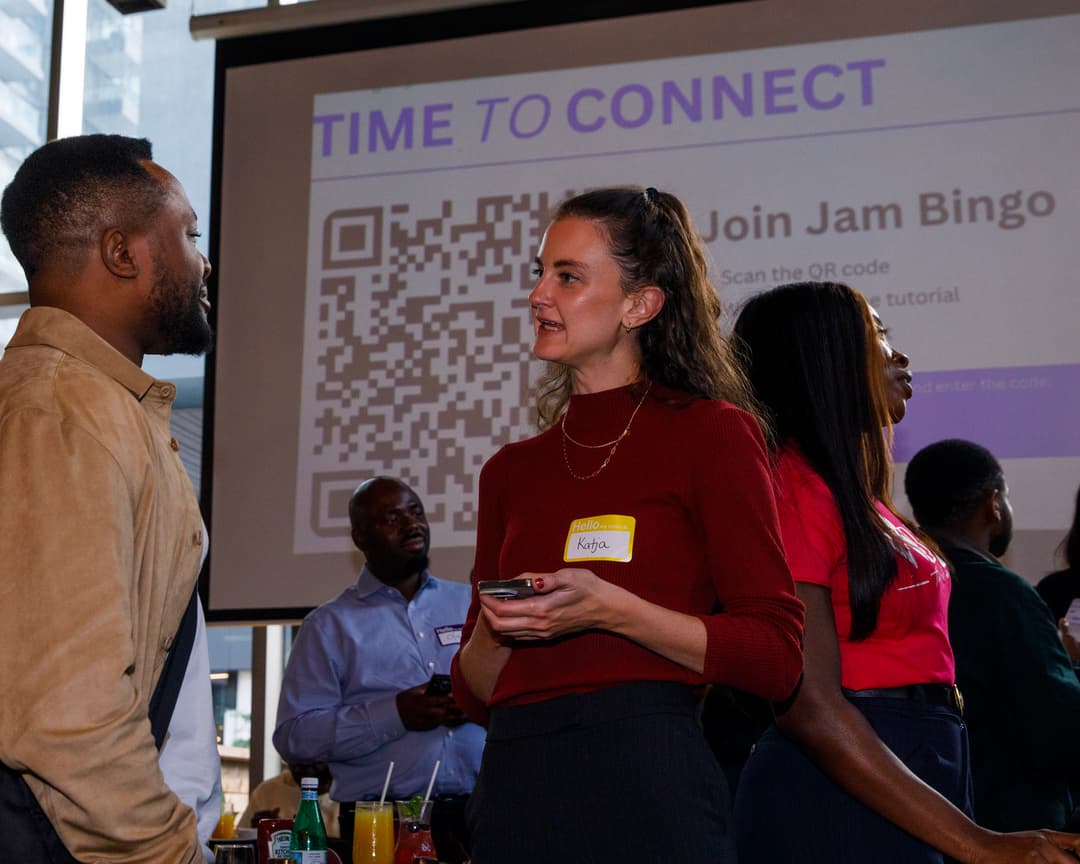
At the annual gathering, display the QR code on the main screen, on the agenda, or on every table. Ask everyone to scan with their phone camera as they arrive.
- 3
Each attendee receives a series of conversation challenges and prompts tailored to the year in review — things like 'Find someone who had a win this year that no one knows about', 'Find someone who learned something the hard way (and will tell you about it)', or 'Find someone who has been here for more than 5 annual gatherings.'
- 4
Attendees walk around the space, approach colleagues they may not talk to daily, and have a real conversation to complete each challenge. Completing a challenge unlocks the next prompt.
- 5
The app guides everything — no paper cards, no manual tracking. Everyone just scans, talks, and connects around the shared experience of the past year.
- 6
The first person to complete all their challenges wins a prize. But the real goal is to make sure by the time the formal program starts, people have already reconnected, laughed, and remembered why they're here together.
- 7
Before the event, set up your Annual Gathering Icebreaker Bingo game. Mix retrospective prompts ('Find someone who had a completely different year than you expected') with forward-looking ones ('Find someone who has a bold hope for next year') and fun ones ('Find someone who can name a meme that defined our company this year').
- 1
How is Jam Bingo Played?
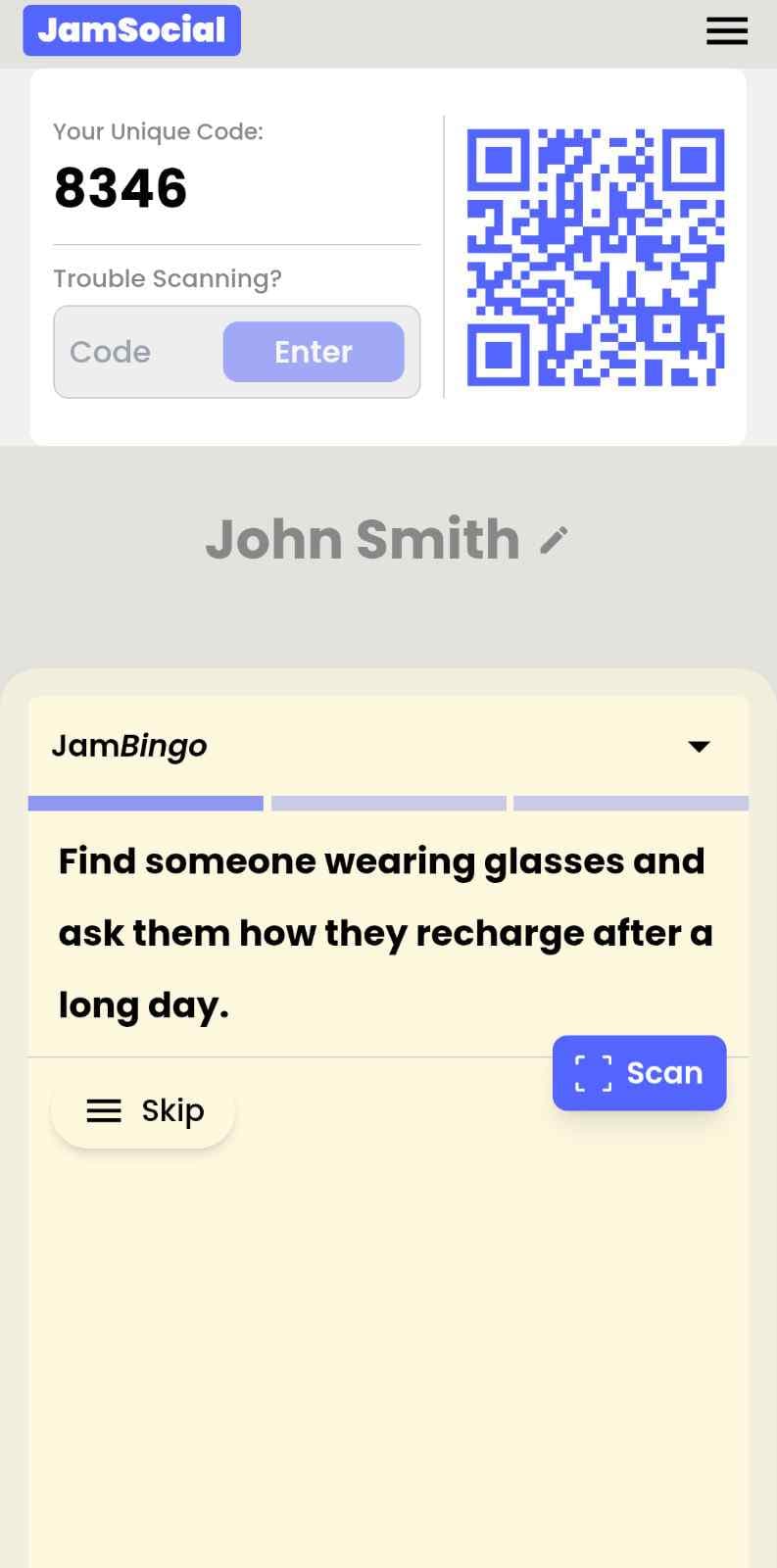
Attendees scan the event’s Jam Bingo QR code (or enter the game code). It runs in the phone’s browser—there is no app to download.
- 2
Conversation Starter
Each person receives a conversation prompt on their phone, like a question to ask someone new.
- 3
Find someone and talk
They find someone who fits the prompt, have the conversation, then scan that person’s QR code (or enter their code) to unlock the next prompt.
- 4
Repeat and connect
Every connection is saved, and the leaderboard shows who met the most new people—perfect for prizes.
The biggest risk at an annual gathering is that people spend the first 30 minutes catching up with the same people they always talk to. This app breaks that pattern. By the time the CEO stands up, the room has already had 50 cross-department conversations. People are warmed up, curious, and present. The app handles all the logistics — you just provide the QR code and watch the year come alive in real conversations.
Everyone who completes all their challenges. First to finish gets a grand prize, but celebrate every completion.
Grand prize: A weekend getaway voucher or a premium company swag bundle. Everyone who finishes: A 'Gathering Champion' digital badge and a shoutout in the follow-up email.
The app gives introverts a perfect script: 'Hey, I have this challenge — would you mind if I asked you about your year?' It removes the 'what do I even say?' paralysis. And they can play at their own pace, in one-on-one conversations, without any whole-room spotlight.
Cambridge Punting (Backwards Communication)
How to play
- 1
In pairs, one person is blindfolded. The other is the 'Punter' (the guide).
- 2
Scatter 'treasures' on the floor. The Punter must guide the blindfolded person to pick up three specific treasures using ONLY words like 'pole left' or 'pole right' (referencing the long pole used to steer a punt boat).
- 3
No 'stop' or 'go' allowed. Only archaic navigation terms.
- 4
Once the treasure is collected, the pair must answer a riddle about the company's history to keep the treasure.
- 5
Switch roles and repeat for several rounds.
- 6
Debrief as a group on what communication challenges arose.
Punting on the River Cam in Cambridge (UK) is famously chaotic because the steerer stands at the back and can't see where they are going. This game replicates that hilarious feeling of miscommunication.
Pair who collects the most treasures in 10 minutes.
British shortbread or a 'Punting Champion' wooden spoon.
The blindfold is great for introverts—nobody sees them looking silly, and they don't have to guide.
Flea Circus (Paper Football)
How to play
- 1
Flick the paper triangle across the table using only your thumb and forefinger (no other fingers).
- 2
Try to land it inside a cardboard box lid turned upside down. If you get it in, you get to ask your partner a 'Deep Question' (e.g., 'What gave you energy this year?').
- 3
If you miss, your partner asks you a 'Shallow Question' (e.g., 'Best lunch you had this month?').
- 4
Play multiple rounds, switching partners occasionally.
- 5
Keep score as a pair or individual.
- 6
End with a group share of favorite moments or questions.
Real flea circuses were a Victorian era novelty where trained fleas appeared to pull tiny carts. This game replaces cruelty with cuteness and forces precision conversation.
Most goals scored.
A tiny magnifying glass or a 'Ringmaster' hat.
Requires intense focus and tiny movements. Perfect for people who hate loud chaos.
Moroccan Tea Porch (Pouring Rituals)
How to play
- 1
Sit in a circle. One person is the 'Host.' They pour liquid from a height (holding the pitcher high up) into a cup held by the 'Guest'.
- 2
The pour must be done in one go without spilling. If the Host spills, they answer: 'What is a project that overflowed its scope this year?'
- 3
If the Guest flinches or drops the cup, they answer: 'What is something you dropped the ball on?'
- 4
The Guest drinks, adds a mint leaf to the pitcher, and becomes the new Host.
- 5
Continue around the circle until everyone has had a turn as both host and guest.
- 6
Close with a group reflection on the rituals observed.
In Morocco, pouring mint tea from a great height is a sign of respect and hospitality meant to create foam. This game turns that ritual into a metaphor for handling high-pressure tasks.
No spills after 3 rounds.
A box of mint tea or a decorative tea glass.
The ritual is calming and repetitive. No shouting, just careful pouring and gentle questions.
Il-Ġostra (The Greasy Pole Question)
How to play
- 1
One person holds the stick horizontally. Another person is blindfolded and spun around 3 times.
- 2
The blindfolded person must walk forward and try to grab the flag tied to the end of the stick, while the stick holder can move it slightly.
- 3
If they miss, they answer: 'What is a goal you reached for but missed?'
- 4
If they grab it, they answer: 'What is a goal you caught against the odds?'
- 5
Rotate players so everyone gets a chance.
- 6
End with a group discussion on goals and resilience.
Il-Ġostra is a traditional Maltese festival event where participants run on a greasy pole over water to grab a flag. This indoor version replaces water and grease with suspense and self-reflection.
Grabbing the flag.
Maltese honey rings (pastizzi) or a 'Flag Bearer' ribbon.
Everyone watches one person at a time. It's about focus, not extroversion. Quiet people often win because they listen for the stick movement.
Chinese Whispers (Shouting Edition)
How to play
- 1
Split into lines of 10 people. The first person reads a corporate jargon phrase from a card (e.g., 'We need to drill down on the low-hanging fruit').
- 2
They WHISPER it to the next person. The catch: There is loud music playing or everyone is shouting.
- 3
The last person says the phrase out loud. It is always wildly mutated.
- 4
The team laughs, then shares: 'What is a real goal we accomplished that sounds like nonsense to outsiders?'
- 5
Repeat with new phrases for several rounds.
- 6
Debrief on communication clarity across the company.
This is a classic parlor game, but the 'Shouting' variant forces people to rely on body language and intuition rather than perfect hearing.
Most accurate translation (or funniest mutation).
A sound-proof headset or a 'Best Listener' trophy.
They don't have to perform; they just have to lean in and listen hard.
Pogu Toss (Korean Fortune Telling)
How to play
- 1
Players toss the 4 beans/coins onto a table. Count how many show heads/tails.
- 2
Consult the 'Pogu Chart': 4 heads = 'Big Success' (Share a win). 0 heads = 'Big Challenge' (Share a struggle). 2 heads = 'Balance' (Share a work-life balance tip).
- 3
Instead of moving pieces, the player just shares the story associated with their fortune.
- 4
Play passes to the left. Keep going until everyone has tossed once.
- 5
Encourage follow-up questions from the group after each share.
- 6
Conclude by noting common themes across fortunes.
While not exactly traditional, this mimics 'Jeom (점)' or fortune-telling games played in Korean households during Lunar New Year (Seollal) to predict the year's luck.
No winner. The 'win' is hearing everyone's fortune.
Korean rice cakes or a small packet of roasted beans.
The beans do the talking. They just need to toss and answer one short question.
Candle Catch (Ethiopian Meskel)
How to play
- 1
Stand in a circle. One person holds a lit (fake) candle and says: 'This year, I carried the light for [Project Name].'
- 2
They toss the candle gently to someone else. That person must catch it and say: 'And I carried the light for [Another Project / Person]'.
- 3
If you drop the candle (or fumble), you must answer: 'What is something heavy I carried this year that I want to put down?'
- 4
The circle continues until everyone has held the candle.
- 5
After the full round, reflect as a group on the passing of responsibility.
- 6
End with a moment of appreciation for collective efforts.
During Meskel (Finding of the True Cross) in Ethiopia, large bonfires (Demera) are lit. People carry torches to symbolize passing light and tradition. This game symbolizes passing the torch of responsibility.
No dropped candles.
A small flashlight or a 'Light Bearer' certificate.
They just need to catch and speak one sentence. If they drop it, they get to share something vulnerable, which often helps them connect.
How to Run Icebreakers at Your Company Annual Gathering (Without Killing the Vibe)
- 01
Start with Icebreaker Bingo App — right at registration
As people check in, have the QR code on the registration desk, on lanyards, and on every table. The app gets people reconnecting before they even find their seats. By the time the first presentation starts, the room has already had 100+ conversations. This single decision changes the entire energy of the day.
- 02
Do Year in Review or Milestone Timeline before the CEO speaks
Don't start with leadership. Start with the team's own stories. Run Year in Review or Milestone Timeline in the first 20 minutes. It warms up the room, surfaces the real wins and learnings, and means the CEO can reference actual team stories in their opening — which lands so much better than generic platitudes.
- 03
Place Appreciation Station right after lunch
Post-lunch energy dip is real. Appreciation Station picks it right back up — the guessing game is engaging, and the appreciations are emotionally lifting. Run it for 20 minutes after dessert. People will leave the session feeling seen, which makes the afternoon sessions so much easier to get through.
- 04
Run Hope Harbor or Time Capsule as the closing interactive before the final keynote
These games look forward, which is the right energy after a retrospective. Run one of them 30 minutes before the closing keynote. Leadership can then reference the hopes or the capsule in their final remarks, creating a through-line that makes the whole day feel cohesive.
- 05
End with Closing Circle — always, without exception
No matter what else you run, end with Closing Circle. It's 5 minutes, it requires no materials, and it leaves people connected. If you only run one icebreaker all day, make it this one. The simultaneous shout and the raised hands are the emotional punctuation your annual gathering needs.
- 06
Assign one facilitator for the whole day (not leadership)
Leadership should present, but they should NOT run the icebreakers. The games need a neutral facilitator — someone from internal comms, HR, or an external facilitator. This keeps the games feeling like 'our time together' not 'their activity for us.' Leadership can join as participants, which is even better — it models vulnerability.
- 07
Post a visible 'Gathering Flow' sign at the entrance
Print a simple timeline: '9:00 — Icebreaker Bingo (scan QR), 9:30 — Year in Review, 10:00 — CEO Welcome, 10:30 — Break, 11:00 — Department Highlights, 12:30 — Lunch, 1:30 — Appreciation Station, 2:00 — Afternoon Sessions, 3:30 — Hope Harbor, 4:00 — Closing Keynote, 4:30 — Closing Circle.' This removes anxiety and helps introverts prepare.
Frequently Asked Questions
How many icebreakers should we run at a full-day annual gathering?
Run 4–5 icebreakers spread across the day. A good rhythm: Icebreaker Bingo App at arrival (20 min), Year in Review after opening (20 min), Appreciation Station after lunch (20 min), Hope Harbor before the closing keynote (20 min), Closing Circle at the very end (10 min). That's 90 minutes of structured connection in an 8-hour day — plenty. The rest is presentations, breaks, and meals. Don't over-program.
What if our annual gathering includes awards and formal recognition?
Then run Appreciation Station BEFORE the formal awards. The anonymous, peer-driven appreciations warm up the room and surface names that formal awards might miss. Then when leadership gives the formal awards, they can reference the Appreciation Station — 'We also heard so many of you mention Maria's kindness today' — which makes the formal moment feel more grounded. The two formats complement each other beautifully.
How do we include remote attendees joining via video?
Icebreaker Bingo App works perfectly — remote attendees scan the QR code on their own screen. For Year in Review, use a shared Miro board where remote attendees place digital sticky notes. For Appreciation Station, remote attendees type appreciations in the chat and the facilitator reads them aloud. For Hope Harbor, use a digital whiteboard. For Closing Circle, remote attendees type their one word in the chat, then everyone in person nods at their cameras. You'll need a co-facilitator managing the virtual room.
What if it's a milestone anniversary (10 years, 25 years, etc.)?
Lean into Milestone Timeline and Team Time Capsule. For a 10-year anniversary, extend the timeline to cover all 10 years. Invite long-timers to place notes on their first year. For the Time Capsule, have people write predictions for the NEXT 10 years. The milestone makes everything more meaningful — lean into the weight of it. And definitely invite founding members (if any) to speak during the Closing Circle.
How do we handle sensitive topics like layoffs or a hard year?
Don't pretend it didn't happen. Year in Review can include 'learnings' that acknowledge difficulty. Hope Harbor can include 'wishes for healing.' But skip Appreciation Station if the year was genuinely traumatic — forced gratitude is harmful. Instead, run Question Cascade (from the Company Update event) to let people anonymously surface what they need. And have mental health support available. The goal isn't forced positivity — it's honest processing.
Do we need to buy special equipment for these games?
Almost nothing. You need sticky notes, markers, pens, a printer for the Icebreaker Bingo QR code, and a large map for Around the World. For Team Time Capsule, you need a box (decorate a cardboard box — it's fine). For Values in Action, you need index cards. For Milestone Timeline, you need butcher paper or chalk. The most expensive item is the world map poster ($20). Everything else is office supplies. The real investment is in the facilitation.
More Networking Game Collections
10 Networking Games for Department Work Dinner
Department Work Dinner · 10 games
10 Networking Games for Your Summer Social
Summer Social · 10 games
Networking Games for Law Firm General Meeting
Law Firm General Meeting · 10 games
10 Networking Games for Chamber of Commerce New Member Orientation
Chamber of Commerce New Member Orientation · 10 games
10 Unique Networking Games for New Student Engagement
New Student Orientation & Welcome Events · 10 games
10 Easy & No-Prep Interactive Networking Games for Professionals
Professional Networking Event · 10 games