20 Networking Games for a Company Annual Partner Showcase
Your partners set up booths to meet your people. These games make sure your people actually show up and talk to them.
20 Networking Games for Your Company Partner Showcase
Duration
Group size
Showing 20 of 20 games
'Ask Me About' Badges
How to play
- 1
Before doors open, give every partner rep a blank sticker and a marker.
- 2
Each rep writes 'Ask me about...' plus one specific, interesting topic — a recent project, an unusual customer, a product most people haven't heard of.
- 3
Reps wear the sticker where it's easy to read from a few steps away.
- 4
Employees are encouraged to walk the floor and open with whatever the sticker says instead of 'so, what do you do?'
- 5
Midway through, the host reminds the room to find a sticker they haven't asked about yet.
- 6
Optional: at the end, invite a few employees to share the most surprising answer they got.
Push partners to be specific. 'Ask me about the time a client asked us to ship a server by canoe' gets a crowd. 'Ask me about our solutions' gets ignored.
No winner — the badges just make every conversation easier to start.
None needed. A shoutout for the partner with the best 'Ask me about' sticker is a fun closer.
The sticker is a built-in opener. A quiet employee just reads it out loud and the partner takes it from there.
Cross-Department Booth Crews
How to play
- 1
Before the showcase, group employees into crews of 3–4 people from different departments. A colored dot on each name badge makes crews easy to find.
- 2
When the showcase opens, crews find each other and visit booths together.
- 3
At each booth, every crew member has to ask the partner one question — so nobody gets to hide behind the most talkative person.
- 4
Crews aim to visit a set number of booths (5–6 works well) before the time is up.
- 5
Encourage crews to split up for the last 10 minutes so everyone makes a few solo connections too.
- 6
Close by asking a couple of crews which partner surprised them the most.
This doubles as a cross-department mixer. People who'd never meet at the office end up spending 45 minutes visiting booths together.
No winner — or give a small prize to the crew that visited the most booths.
A group prize like a team lunch voucher works better than individual prizes here.
Walking up to a booth in a group of four is a lot less intimidating than walking up alone.
Jam Bingo - Large Group Networking Game
How to play
- 1
Give every partner real conversations with your employees, not just the booths closest to the entrance.
- 2
Before the showcase, write one conversation prompt for each partner — like 'Find someone from the XYZ booth and ask them about a product or service they offer that most people do not know about.'
- 3
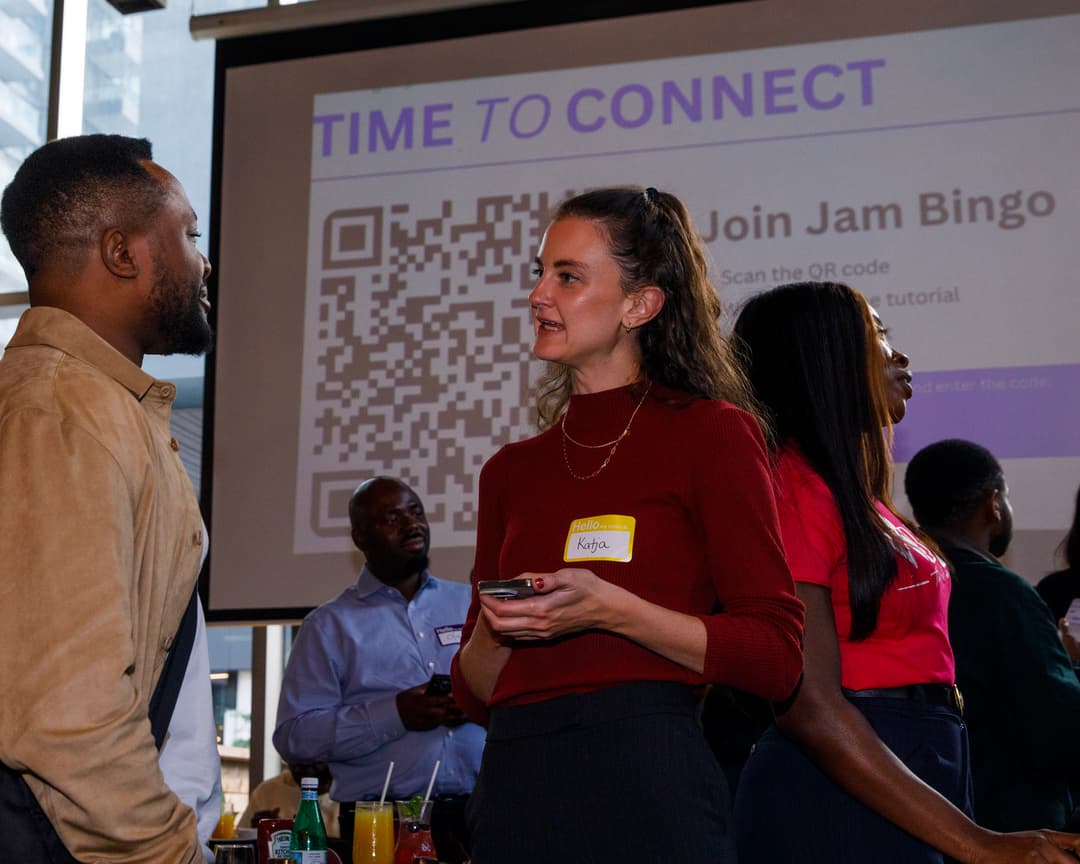
Put the Jam Bingo QR code on the big screen and TVs around the venue, and place a few extra printed QR codes around the networking space.
- 4
Once everyone has arrived, have your emcee ask the room to scan the QR code. Each employee gets their first partner prompt on their phone — no app to download.
- 5
Employees head to that partner's booth and have the conversation. When they're done, they scan the partner rep's QR code (or enter their code) to unlock their next prompt.
- 6
Prompts show up in random order for each person, so employees spread out across every booth instead of crowding the ones by the entrance.
- 7
At the end, pull up the leaderboard and award prizes to the employees who met the most partners.
- 1
How is Jam Bingo Played?
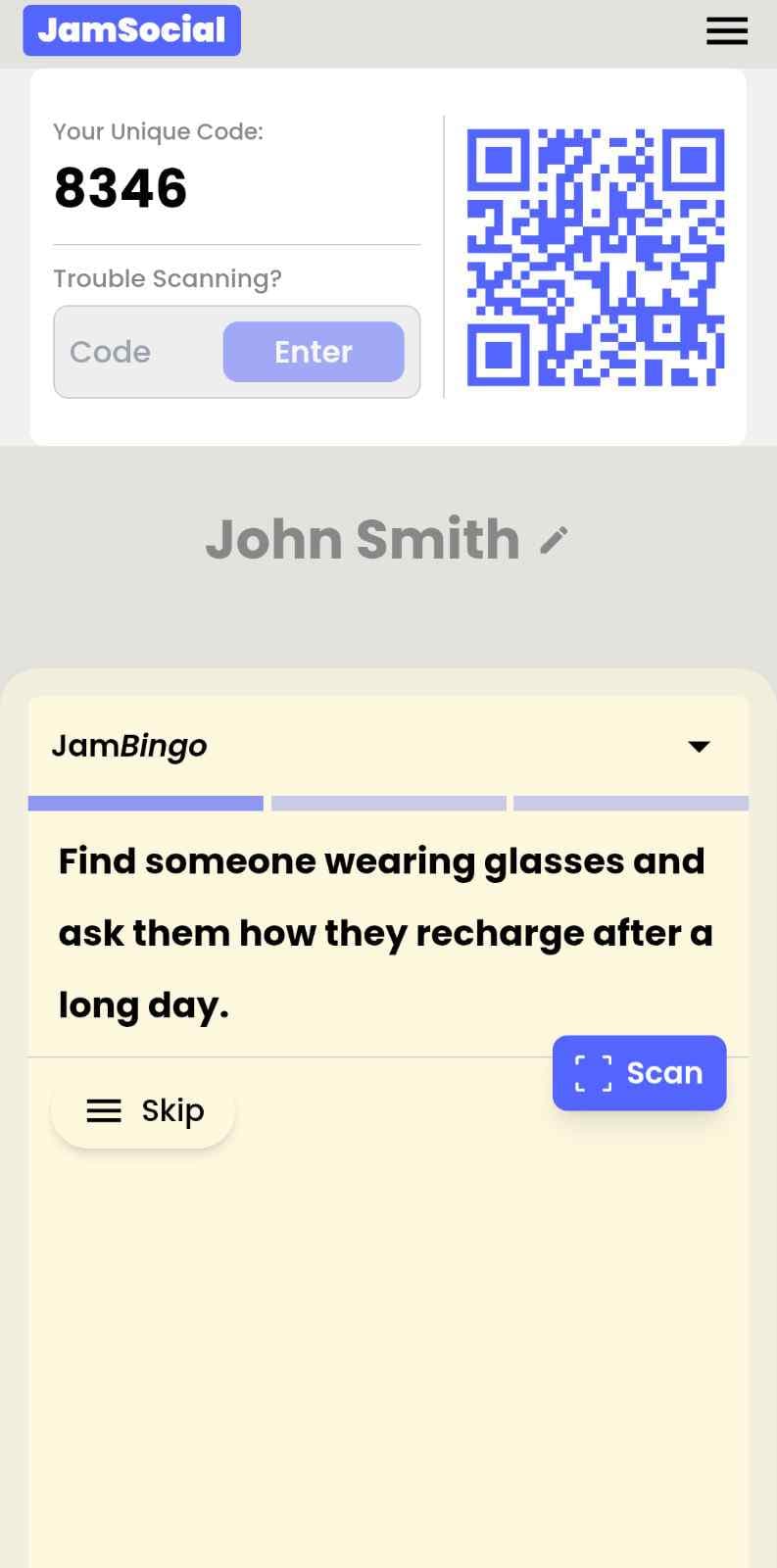
Attendees scan the event’s Jam Bingo QR code (or enter the game code). It runs in the phone’s browser—there is no app to download.
- 2
Conversation Starter
Each person receives a conversation prompt on their phone, like a question to ask someone new.
- 3
Find someone and talk
They find someone who fits the prompt, have the conversation, then scan that person’s QR code (or enter their code) to unlock the next prompt.
- 4
Repeat and connect
Every connection is saved, and the leaderboard shows who met the most new people—perfect for prizes.
Evotek wrote 51 prompts for their 51 partners and saw a lot more participation once the QR code was on the big screen — with extra codes placed around the networking space.
The leaderboard shows who made the most connections. Award the top networkers at the end.
Swag, gift cards, or a product from one of your partners. Save the announcement for the end so people don't rush their conversations.
Every booth visit starts with a ready-made question, so nobody has to walk up to a sponsor and figure out what to say.
Booth Number Draw
How to play
- 1
Write every booth number on slips of paper — enough for each attendee — and put them in a bowl at the entrance.
- 2
As employees arrive, each one draws a slip.
- 3
Their first stop of the showcase has to be the booth on their slip, no trading allowed.
- 4
At that booth, they have one real conversation before exploring on their own.
- 5
For a second round later in the showcase, pass the bowl around again.
- 6
Make sure booths at the back of the venue have plenty of slips in the bowl.
This is the low-tech way to fix the biggest partner showcase problem: everyone crowding the booths near the door while partners at the back stand alone.
No winner — the goal is spreading foot traffic across every booth.
None needed.
The slip decides where to go, so quiet employees don't have to pick a booth or justify why they're there.
Partner Trivia Walk
How to play
- 1
Before the event, ask each partner for one fun fact about their company that isn't on their website or booth banner.
- 2
Tell the room at the start: there's a trivia round at the end, and the answers are only available by talking to the partners.
- 3
Employees visit booths and chat with partners — who share their fun fact during the conversation.
- 4
Near the end of the showcase, gather everyone for a quick 5–10 question trivia round.
- 5
Employees answer in small teams, pooling what they learned at different booths.
- 6
Reveal each answer and let the partner behind it say a sentence or two about it.
Keep the facts conversational ('What was this company's first product?') rather than salesy. Nobody wants a trivia question about pricing tiers.
The team with the most correct answers wins.
A prize from one of the partners makes the win feel connected to the showcase.
Teams pool answers, so quiet employees contribute what they learned without having to shout anything out.
Customer Story Hunt
How to play
- 1
Give everyone one mission: at each booth, ask the partner for their favorite customer story.
- 2
Employees collect as many stories as they can during the showcase.
- 3
Encourage follow-up questions — what went wrong, what surprised them, what they'd do differently.
- 4
Near the end, the host asks a few employees to share the best story they heard in 30 seconds.
- 5
Let the partner behind the story add one line if they'd like.
- 6
Close by thanking the partners for sharing.
Stories beat product pitches every time. Partners get to talk about their work in a way that's actually memorable, and employees walk away understanding what the partner really does.
No winner — or a small prize for the best story shared at the end.
A shoutout for the 'Story of the Showcase' is plenty.
Asking for a story means the partner does most of the talking. Quiet employees just have to listen and ask a follow-up.
Paper Passport Stamps
How to play
- 1
Print a passport for each employee with a spot for every partner booth.
- 2
Give each partner rep a unique stamp or sticker.
- 3
Employees visit booths and get their passport stamped after a conversation with the partner.
- 4
Set a minimum number of stamps to be entered into a prize draw.
- 5
Collect passports at the end and count them up.
- 6
Draw winners from the completed passports.
This is the classic option and it works well for smaller showcases. With hundreds of employees, printing, handing out, and counting passports gets heavy — which is why many companies move to a digital version as they grow.
Everyone who reaches the minimum number of stamps is entered into the draw.
A raffle-style draw with a few prizes keeps it exciting without making it a race.
The passport gives everyone a clear reason to walk up to each booth.
60-Second Demo Rounds
How to play
- 1
Split employees into small groups and assign each group a starting booth.
- 2
When the bell rings, each partner gives their group a 60-second demo or story — no slides.
- 3
Groups get one minute of questions after the demo.
- 4
The bell rings again and groups rotate to the next booth.
- 5
Run 5–8 rotations depending on your time.
- 6
Afterward, open the floor for free mingling so employees can go back to the booths they liked most.
This is the most structured game on the list — great for making sure every partner gets seen, but keep it short and follow it with free mingling so it doesn't feel like a workshop.
No winner.
None needed.
The partner does the talking, and questions are optional, so nobody is put on the spot.
Partner Connection Shoutouts
How to play
- 1
Save this one for the end of the showcase.
- 2
Ask the room: 'Who learned something today that could help your team?'
- 3
Invite 4–6 volunteers to share in one sentence which partner it was and what they learned.
- 4
Ask the partner to raise a hand so everyone knows who to follow up with.
- 5
Keep each shoutout short — the energy comes from the pace.
- 6
Close with a thank-you to all the partners for being there.
This gives partners a public moment of recognition and reminds employees to actually follow up after the event.
No winner.
None needed — the shoutout is the reward for the partner.
Volunteers only. Never call on someone directly.
Partner Photo Wall
How to play
- 1
Set up a shared photo album or event hashtag before the showcase.
- 2
Encourage employees to snap a photo with the partner reps they talk to.
- 3
Display the photos on a screen near the refreshments as they come in.
- 4
Partners can share the photos afterward on their own channels.
- 5
Near the end, the host can highlight a few of the best photos.
- 6
Share the full album with partners and employees after the event.
Partners love walking away with content from your event — it's an easy extra they'll remember.
No winner.
Optional: a small prize for the best photo of the showcase.
Photos are optional. Quiet employees can just enjoy the wall without posting anything.
Partner Speed Rounds
How to play
- 1
Set up a row of seats for partner reps and a facing row for employees.
- 2
Each pair gets three minutes: the employee explains what their team works on, and the partner explains how they help companies like yours.
- 3
When the bell rings, employees move one seat down and meet the next partner.
- 4
Run five to eight rounds so every employee meets several partners.
- 5
Employees jot down one partner they want to follow up with before they leave the row.
Put partners who rarely get foot traffic in the speed rounds. It guarantees them real conversations even if their booth is in a quiet corner of the room.
No winner — success is every employee meeting several partners they wouldn't have visited on their own.
None needed, though a small thank-you gift for partner reps who sit in goes a long way.
Three minutes, one person, and a clear script ('here's what my team does') is far easier than walking up to a busy booth.
The Problem Wall
How to play
- 1
Put up a large 'Problem Wall' near the entrance.
- 2
As employees arrive, they write one work problem they're trying to solve on a sticky note and add their name and department.
- 3
Partners browse the wall and 'claim' notes they think they can help with by adding their company name.
- 4
Partners then find the employee who wrote the note (or invite them to their booth) for a conversation.
- 5
Near the end, the host reads out a few problems that got solved or found a great lead.
Ask partners to walk the wall before the showcase opens. The best conversations of the day start with 'I saw your note — we do exactly that'.
No winner — the goal is for every note to get at least one partner conversation.
Recognize the partner who claimed and followed up on the most notes.
Employees only have to write a note — the partners come and find them.
Department Bounty Questions
How to play
- 1
Before the event, give each department a 'bounty' — a real question they want answered, like 'Which partner can speed up our onboarding?'
- 2
Teams split up and visit booths to find the partners who can answer their bounty.
- 3
Each team writes down the best answer and the partner who gave it.
- 4
Teams regroup near the end and share their answers with the room in one minute.
- 5
The host announces which partner answered the most bounties.
Bounties turn a partner showcase into something employees actually need — they walk away with answers, not just swag.
The department that finds the best answer to its bounty (voted by the room).
A team lunch for the winning department, and a 'Most Helpful Partner' shoutout.
Teams split the booth visits, so no one has to carry every conversation alone.
Reverse Booth Tour
How to play
- 1
Flip the showcase for one block: departments set up small tables with a sign, and partner reps do the walking.
- 2
Partners visit department tables to learn what each team does and what's on their plate this year.
- 3
Each department prepares one question they'd love partners to answer.
- 4
Partners rotate every five to seven minutes.
- 5
Switch back to the normal booth setup afterwards — partners now know exactly who to talk to.
Run this early in the day. Partners who understand your departments first have much better conversations at their own booths later.
No winner.
None needed.
Employees stay at their own table with their teammates while partners come to them.
Two Truths and a Feature
How to play
- 1
At each booth, the partner shares three statements about their company or product: two true, and one made-up 'feature'.
- 2
Visiting employees guess which feature is fake.
- 3
The partner reveals the answer and explains the two true statements.
- 4
Employees who guess correctly get a stamp, sticker, or raffle ticket.
- 5
Visit as many booths as possible during the networking block.
Ask partners to make the fake feature believable but fun. The best ones spark a 'wait, you should actually build that' conversation.
The employee with the most correct guesses.
A partner-donated gift or a raffle entry for each correct guess.
Guessing is all employees have to do — the partner does the talking.
Partner-Hosted Table Topics
How to play
- 1
Ask each partner to host one table with a topic their company knows well — not a sales pitch, but a real conversation topic.
- 2
Employees choose a table that interests them for the first round.
- 3
Each round runs 10 minutes, then employees move to a new table.
- 4
Run two or three rounds.
- 5
Partners share one takeaway from their table with the whole room at the end.
Review topics ahead of time and steer partners away from product pitches. 'How other companies handle hybrid onboarding' beats 'Introducing our onboarding platform'.
No winner.
None needed. Thank each host by name at the closing.
Employees pick a topic they're comfortable with and can listen for a round before joining in.
Booth Token Vote
How to play
- 1
Give every employee three tokens at check-in.
- 2
Employees can only drop a token in a partner's jar after a real conversation at that booth.
- 3
Partners can't ask for tokens — they have to earn them.
- 4
Count the jars at the end of the showcase.
- 5
Announce the People's Choice partner during the closing remarks.
Limiting everyone to three tokens makes each one feel valuable — and pushes employees to visit several booths before deciding.
The partner with the most tokens wins People's Choice.
A People's Choice award for the partner, and a raffle for employees who used all three tokens.
The token gives employees a simple reason to walk up to a booth, and dropping it in the jar is a no-pressure way to say thanks.
90-Second Pitch Battle
How to play
- 1
Invite partners to give a 90-second pitch on stage — one partner at a time.
- 2
The pitch must answer one question: 'How would you make our employees' day easier?'
- 3
The host keeps strict time. When 90 seconds are up, the mic goes to the next partner.
- 4
Employees vote for their favorite pitch with a show of hands or a quick poll.
- 5
Employees then head to the booths of the pitches they liked most.
Run the pitch battle right before the networking block. It gives every employee a shortlist of booths to visit and a question to open with.
The partner with the most votes.
A 'Best Pitch' award and a prime booth spot at next year's showcase.
Employees just watch and vote, then walk into booth conversations already knowing what the partner does.
Who Solves This? Scenario Cards
How to play
- 1
Write scenario cards based on real situations at your company, like 'A new hire's laptop hasn't arrived on day one' or 'The team needs a venue for 200 people next month'.
- 2
Hand each employee (or pair) one card.
- 3
Employees visit booths to find the partner who can best solve their scenario.
- 4
Once they've found a match, the partner writes their name on the card.
- 5
Collect the cards and share the most creative matches at the closing.
Scenario cards show employees where each partner actually fits into their day — which makes follow-ups far more likely after the showcase.
Every card matched with a partner. Optionally, the room votes on the best match.
Partner-donated prizes drawn from the completed cards.
The card is the conversation starter — employees just read their scenario to the partner.
Jam Bingo - Cross-Department Partner Mixer
How to play
- 1
Connect your partners with employees across every department, not just the people they already know.
- 2
Before the showcase, create a Jam Bingo game with prompts that mix partners and colleagues — 'Find a partner who works with a team like yours' or 'Find a colleague from a department you've never worked with'.
- 3
Display the QR code at the entrance, on the main screen, and at the welcome table. Employees and partners scan it with their phone camera.
- 4
Each person gets a conversation prompt on their phone, finds someone who fits it, and has the conversation.
- 5
They scan the other person's QR code to unlock the next prompt — so partners and employees keep meeting new people all day.
- 6
Share the leaderboard at the closing and recognize the people who made the most connections.
- 1
How is Jam Bingo Played?
Attendees scan the event’s Jam Bingo QR code (or enter the game code). It runs in the phone’s browser—there is no app to download.
- 2
Conversation Starter
Each person receives a conversation prompt on their phone, like a question to ask someone new.
- 3
Find someone and talk
They find someone who fits the prompt, have the conversation, then scan that person’s QR code (or enter their code) to unlock the next prompt.
- 4
Repeat and connect
Every connection is saved, and the leaderboard shows who met the most new people—perfect for prizes.
Invite partners to play too. When partner reps are part of the game, employees have a natural reason to walk up to them — and partners meet people beyond the usual booth visitors.
The people who make the most connections on the leaderboard.
Partner-sponsored prizes presented at the closing, so partners get a moment in front of everyone too.
The prompt gives everyone a built-in opener, so no one has to come up with small talk to start a conversation.
How to Run Networking Games at Your Company Partner Showcase
- 01
Start once everyone has arrived
The least favourable time to start is while people are still walking in. Latecomers feel lost and you'll end up re-explaining the activity to every new arrival. Give people time to arrive and grab a drink, then kick things off.
- 02
Pick one main game and one closer
For a partner showcase, one main booth-visiting game (like Jam Bingo or Booth Number Draw) plus a short closer (like Partner Connection Shoutouts) is plenty. More than that starts to feel like a workshop.
- 03
Get your partners involved before the day
Ask each partner for a prompt, a fun fact, or an 'Ask me about' topic ahead of time. Partners who know the game is coming are ready to talk when employees walk up.
- 04
Make the QR code or instructions impossible to miss
Put the QR code or game instructions on the big screen and TVs around the venue, and have your emcee introduce the activity. Evotek saw a lot more participation once the QR code was on the big screen.
- 05
Avoid running games while people are eating
Participation drops when people are juggling plates. Run your main game before food is served, or during a dedicated networking block.
- 06
Save prizes for the very end
Announcing prizes too early makes people rush through booth visits. Save the announcement for the end so employees focus on real conversations with your partners.
Frequently Asked Questions
What is the best networking game for a company partner showcase?
For showcases with 100 or more employees, a phone-based game like Jam Bingo works well: employees scan one QR code, get a conversation prompt for each partner booth, and prompts show up in random order so traffic spreads across every booth. For smaller showcases, 'Ask Me About' badges or paper passport stamps are simple options.
How do you get employees to visit partner booths at the back of the venue?
Spread traffic on purpose. Booth Number Draw assigns each employee a first booth, and Jam Bingo shows each person the partner prompts in a random order — both send people to booths they'd otherwise walk past.
How long should networking games run at a partner showcase?
Plan for a dedicated networking block — 45 to 90 minutes works for most showcases. Run your main game during that block, then close with a quick 10-minute activity like Partner Connection Shoutouts.
Should we give out prizes?
Prizes help, especially with competitive teams like sales. Swag, gift cards, or a product from one of your partners all work. Just save the prize announcement for the end so people don't rush through their conversations.
How do we get partners involved in the games?
Ask partners before the event for a conversation prompt, a fun fact, or an 'Ask me about' topic. When partners know the game is happening, they're ready with something interesting to say when employees walk up.
More Networking Game Collections
25 Icebreakers for an Association AGM & Tradeshow Mixer
Association AGM & Tradeshow Mixer · 25 games
10 Team Ice Breaker Activities for Your Company Picnic
Company Picnic · 10 games
11 Church Anniversary Networking Games
Church Anniversary · 11 games
10 Networking Games for Marketing Department Retreat
Marketing Department Retreat · 10 games
10 Networking Games for Work Sundowner
Work Sundowner · 10 games
10 Networking Games for Company Update Event
Company Update Event · 10 games