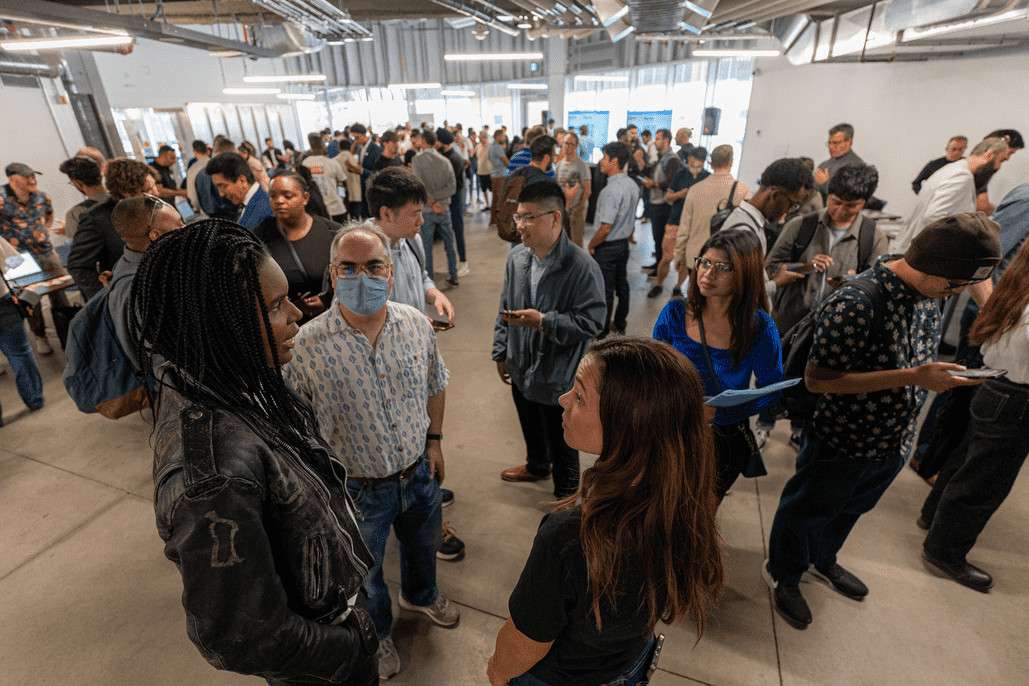
9 Large Group Networking Ice Breakers
Below are 9 Interactive networking ice breakers to help get attendees talking with one another.

1. Human Bingo
— for 20 to 50 people
Time: 15-20 min. Materials: printed bingo cards, one per person.
How to run Human Bingo: hand out cards with squares like 'has traveled to 3+ countries' or 'started this year.' Attendees walk the room finding matches and getting squares signed. First full row calls bingo.
Tip: keep squares specific to your group. 'Works in a department you've never worked with' beats 'likes coffee' every time.
2. Speed Networking Rounds
— for 50 to 150 people
Time: 20-25 min. Materials: a timer and a way to signal rotation (bell, chime, or announcement).
How to run it: split the room into two facing lines or circles. Give each pair 2 minutes with a single prompt on screen, like 'what's a project you're proud of right now.' Sound the chime, one line rotates, repeat 8-10 times.
Tip: change the prompt every 2-3 rounds so conversations don't get repetitive by round 8.
3. Find Someone Who Scavenger Hunt
— for 150 to 500 people
Time: 45-50 min. Materials: a printed passport card or a phone-based version.
- Find someone from a department you've never worked with.
- Find someone attending a different session track than you.
- Find someone who's attended this event before.
- Find someone who works in a completely different industry.
How to run it: attendees collect a signature, sticker, or digital check-in for each prompt they complete by finding a matching person. Whether you use paper passports or a phone-based tool, the prompts are what actually do the work, not the format.
Tip: at this size, self-guided beats facilitator-led every time. Expect a few extra minutes for everyone to get moving. That's normal.
4. Color-Coded Mingling
— for 500+ people
Time: 20-30 min. Materials: colored stickers, lanyard tags, or wristbands, one color per category (region, role, years at company).
How to run it: assign colors at check-in. Post a simple rule on signage, like 'find someone wearing a different color than you and swap one fact.' People self-sort without needing any central coordination.
Tip: skip trying to regroup everyone with an announcement. Let it run continuously through the mingling window and wind down naturally into the main program.
5. Jam Bingo (Bonus)
— No-Prep Interactive Networking Activity for 100+ People
Get people having meaningful conversations and meeting as many new people as possible.
You're looking for a simple and organic way to incentivize people to interact with each other.
- Jam Bingo is a networking game; Not too structured, easy to set up, and simple for large groups to participate in. It's simple way to get people talking!
Time: 45-60 min. Materials: none besides a screen or signage with a QR code.
How to run it: attendees scan the QR code, get a prompt on their own phone, and go find someone in the room who matches it, all without printed materials or a facilitator managing the room.
Tip: this is the pick when you don't have time to print bingo cards, write custom trivia, or set up color-coded stations. A solid default for any group over 100 when you're short on prep time.
6. Conferences
Topic-Based Speed Rounds
Topic-based speed rounds are a version of speed networking where attendees rotate through short, timed conversations grouped by session track or subject of interest instead of random pairing. Since conference attendees are usually strangers from different companies, run topic-based speed rounds during registration or the opening mixer, when people are already standing around waiting for the program to start.
7. Corporate All-Hands
Department Trivia
Department trivia is a light trivia game played in mixed teams, with one person pulled from each department and a rule that no two people from the same team can sit together. Run a few rounds of trivia about the company itself, its history, its milestones, its inside jokes, so the questions give people a reason to lean over and talk between rounds. Department trivia works well at an all-hands specifically because employees already know their own team; the mixed-team rule is what forces the cross-department mixing that a normal seating chart won't.
8. Alumni and Association Mixers
Decade Stations
Decade stations are physical stations set up around the room, each labeled with a graduation decade or chapter era. Attendees start at the station matching their own decade, then get a prompt to visit one station from a different decade and ask what's changed since they were there. Decade stations work particularly well for alumni and association mixers because the crowd is a mix of people who already know each other and people meeting for the first time, and the station format gives both groups an obvious reason to move.
9. Virtual and Hybrid Events
Breakout Rotations
Breakout rotations split a virtual or hybrid audience into small groups of 4-5 people across 3-4 short rounds, with a new discussion prompt for each round. Breakout rotations work for virtual and hybrid events specifically because there's no physical room to walk across, so the scheduled rotation and prompt have to do the job that simply swapping seats would do in person. Give remote attendees the same prompts as anyone mingling in person so breakout rotations feel like one shared activity instead of two separate ones.
The Facilitator Cheat Sheet
Frequently Asked Questions
What's the best icebreaker for a group over 200 people?
Something self-guided, since it doesn't rely on a facilitator managing individual interactions. A scavenger-hunt style activity, whether paper or phone-based, tends to work well at this size.
How long should a large group icebreaker take?
15 to 20 minutes for a warm-up activity. Shorter and there's no time for a real conversation. Or, 45 to 90 minutes for a full interactive activity.
Do ice breakers work for groups that already know each other?
Yes, as long as prompts target the specific gap you're closing, like cross-department mixing at an all-hands or cross-decade mixing at an alumni event.
What if my group is a mix of introverts and extroverts?
A structured prompt or rotation helps introverts more than extroverts, since it removes the pressure of starting a conversation from nothing.
Did this blog help?
Were you instead looking for:
Ice breaker for a large group (100+ people)