7 Icebreakers for 100+ People
Seven icebreakers built for large groups.
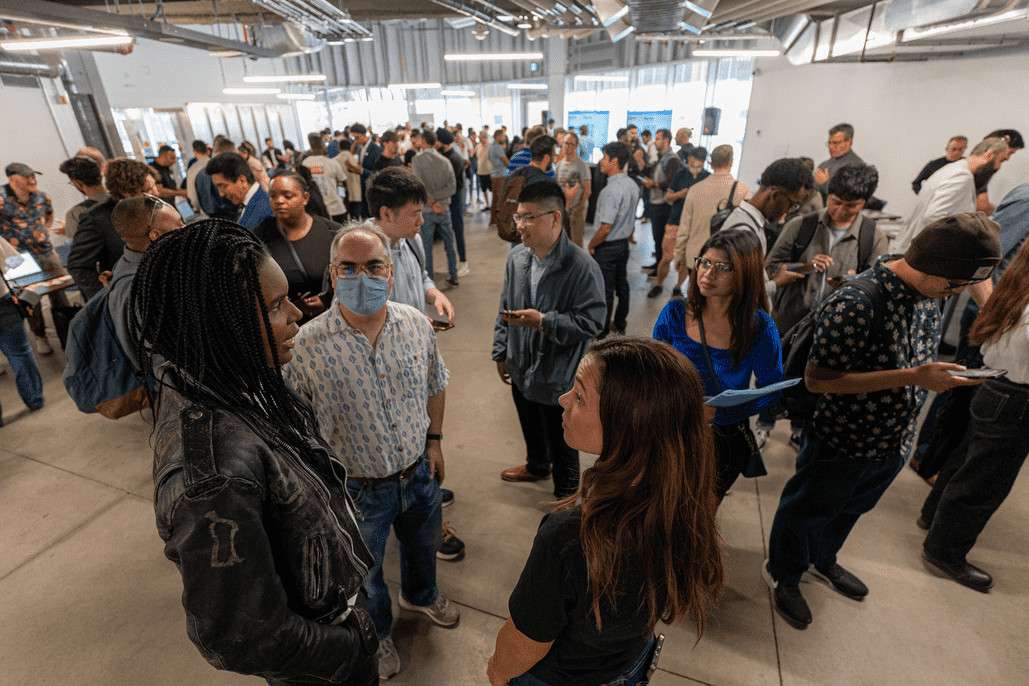
Once a room has more than 100 people, attendees tend to stick with the people they already know.
This defeats the whole purpose of networking.
So, how can you make networking interactive for a large group?
Especially when you can't hand a piece of paper to everyone, and you definitely can't rely on a 'free-for-all' to get people talking.
Below are 7 icebreakers that were well for interactive networking sessions of 100+ attendees.

1. QR Code Networking Bingo
for 100 to 1,000+ people
Time: 30-60 min. Materials: none besides a screen or signage with a QR code.
How to run it: attendees scan a QR code and get a conversation prompt on their own phone, then walk the room to find someone who matches it. There's no facilitator managing individual interactions, no paper to print, and no line for instructions, so it scales from a classroom to an auditorium without any extra setup.
Tip: this is usually the easiest pick when you're short on prep time. Everyone already has the one thing the activity needs, a phone.
2. Human Bingo App
for 50 to 200 people
Time: 15-20 min. Materials: printed bingo cards, one per person.
How to run it: hand out cards with squares like "has traveled to 3+ countries" or "started this year." Attendees walk the room finding matches and getting squares signed. First full row calls bingo.
Tip: keep the squares specific to your group. "Works in a department you've never worked with" gets a lot more movement than "likes coffee."
3. Speed Networking Rounds
for 100 to 300 people
Time: 20-25 min. Materials: a timer and a way to signal rotation, like a bell or a chime.
How to run it: split the room into two facing lines or circles. Give each pair 2 minutes with a single prompt on screen, then sound the chime and rotate one line. Repeat 8-10 times so everyone gets several short conversations instead of one long one.
Tip: swap the prompt every 2-3 rounds. By round 8, the same question starts feeling like a script.
4. Find Someone Who Scavenger Hunt
for 150 to 500 people
Time: 45-50 min. Materials: a printed passport card, or a phone-based version.
- Find someone from a department you've never worked with.
- Find someone attending a different session track than you.
- Find someone who's attended this event before.
- Find someone who doesn't know anyone else in the room yet.
How to run it: attendees collect a signature, sticker, or digital check-in for each prompt they complete. The prompts are what actually pull people toward strangers, not the format you print them on.
Tip: at this size, self-guided beats facilitator-led every time. Give people a few extra minutes to get moving. That's normal.
5. Color-Coded Mingling
for 200+ people
Time: 20-30 min. Materials: colored stickers, lanyard tags, or wristbands, one color per category like region, role, or years at the company.
How to run it: assign colors at check-in and post one simple rule on signage, like "find someone wearing a different color and swap one fact." People sort themselves without any central coordination needed.
Tip: don't try to regroup everyone with an announcement. Let it run through the mingling window and wind down naturally into the main program.
6. Group Trivia
for 100 to 400 people
Time: 20-30 min. Materials: a screen, a mic, and a rule that mixed teams sit together.
How to run it: pull one person from each existing team or department onto a new mixed team, so no two people from the same group end up together. Run a few rounds of trivia about the organization itself, its history, milestones, and inside jokes, so the questions give people a reason to lean over and talk between rounds.
Tip: the mixed-team rule is doing most of the work here. Without it, people just sit with whoever they already know.
7. Common Ground Circles
for 100 to 250 people
Time: 15-20 min. Materials: none, just open floor space.
How to run it: break the room into circles of 8-10 people. Give the whole room one shared prompt, like "share a hobby outside of work," and let each circle talk it through on their own for a few minutes before rotating a couple of people between circles.
Tip: this one works best as a warm-up before a bigger activity. It's low-pressure enough to loosen up a room that hasn't spoken to each other yet.
The Facilitator Cheat Sheet
1-hour interactive ice breaker activity for a large group of professionals
Frequently Asked Questions
What's the best icebreaker for exactly 100 people?
Anything self-guided works well right at 100, since you're past the point where one facilitator can run the whole room by hand. QR Code Networking Bingo or Human Bingo App are both solid starting points.
How much time should I budget for a large group icebreaker?
15 to 20 minutes for a quick warm-up, or 45 to 60 minutes if you want it to double as the main networking activity for the event.
Do these work for a group that already knows each other?
Yes, as long as the prompts target the specific gap you're trying to close, like cross-department mixing at an all-hands or cross-team mixing at a conference.
What if I don't have budget for printed materials?
Go with a phone-based option like QR Code Networking Bingo or Color-Coded Mingling. Both skip printing entirely and still scale past 500 people.