10 Ice Breaker Games for Department Work Dinner
Ice breaker activity to help colleagues interact and get to know each other.

10 Icebreakers for Your Department Work Dinner
Duration
Group size
Showing 10 of 10 games
Story Dice
How to play
- 1
Before the dinner, prepare a set of word slips for each table — think objects, emotions, places, and verbs. Examples: 'deadline,' 'elevator,' 'unexpected,' 'Tuesday,' 'relief,' 'the CEO.'
- 2
Each person at the table rolls the die. The number they roll corresponds to a word slip they draw from the stack (1 = first slip, 2 = second, etc.).
- 3
Going around the table, each person must tell a true story from their life — work-related or not — that somehow involves their word. Maximum 60 seconds. No exceptions.
- 4
After everyone has gone, the table votes on the most surprising story. That person draws another word and goes again as a bonus round.
- 5
The rule: stories must be true. Embellishing is allowed. Making things up is immediately called out by the group with a dramatic gasp.
- 6
The person whose story got the most 'wait, seriously?' reactions wins the round.
The word prompt removes the blank-page anxiety of 'tell us something about yourself.' It gives people a direction without boxing them in. You'll hear things about coworkers that would never come up in a meeting — which is exactly the point.
Person whose story got the most genuine reactions around the table wins.
A 'Best Story' ribbon, a $10 restaurant voucher, or they get to choose the dessert order for the table.
The 60-second cap is a gift — quiet folks know exactly when they're done. And the word prompt means they never have to decide what to say. Just connect the word to something true. That's it.
Assumption Swap
How to play
- 1
Give everyone two cards. On card one, they write something they assume most people at the dinner believe about them based on their job title or department. On card two, they write something that is completely true about them that would surprise most people at the table.
- 2
Cards are collected separately — all the assumption cards in one pile, all the surprise cards in another.
- 3
The facilitator reads an assumption card. The group guesses whose it is. Then the person reveals themselves and reads their surprise card.
- 4
The group discusses: 'How far off was the assumption?' The person who guessed correctly gets a point.
- 5
Keep going until all cards are read. The person with the most correct guesses wins.
- 6
Close with one final question to the whole table: 'What's one assumption you're letting go of tonight?'
This is one of the best ice breakers for work dinners because it directly targets the thing that kills cross-department connection — people only knowing each other by their role. By the end of this one, someone from finance will have revealed they used to be a nightclub DJ. And everything changes after that.
Person with the most correct 'whose card is this?' guesses wins.
A 'Mind Reader' mug, a bottle of wine for the table, or the winner picks the after-dinner music for 10 minutes.
Writing the cards is private. Revealing themselves is optional — they can just nod when the facilitator reveals the answer. The surprise card does the talking for them.
Where in the World (Table Map)
How to play
- 1
Place a large blank world map in the center of each table before guests arrive.
- 2
As people sit down, invite them to put a dot (or their initials) on three places on the map: where they were born, where they've lived the longest, and one place they dream of going.
- 3
Once everyone has marked their spots, the table spends 10 minutes asking each other about their marks. The only rule: you can't explain your own mark unless someone asks about it.
- 4
The person who has the most unexpected combination of three dots wins the round — voted by the table.
- 5
Optional: if two people share a dot location (same city, same dream destination), they automatically become dinner partners for the next course and must find one more thing they have in common.
This is one of the easiest and most visually satisfying ice breaker games for work dinners. The map is the conversation starter — people drift toward it naturally before anyone has to say a word. And finding a shared dot location creates an instant connection that feels genuinely exciting.
Most unexpectedly interesting three-dot combination, voted by the table.
A scratch-off world map they can actually use, a travel-sized gift set, or dessert is on the department for the winning table.
This is a writing-and-pointing game at its core. Quiet folks can participate entirely by marking their dots and letting others ask them questions — no need to speak up unprompted.
Business Networking Bingo App
How to play
- 1
Easy & quick way to get people interacting and talking with each other.
- 2
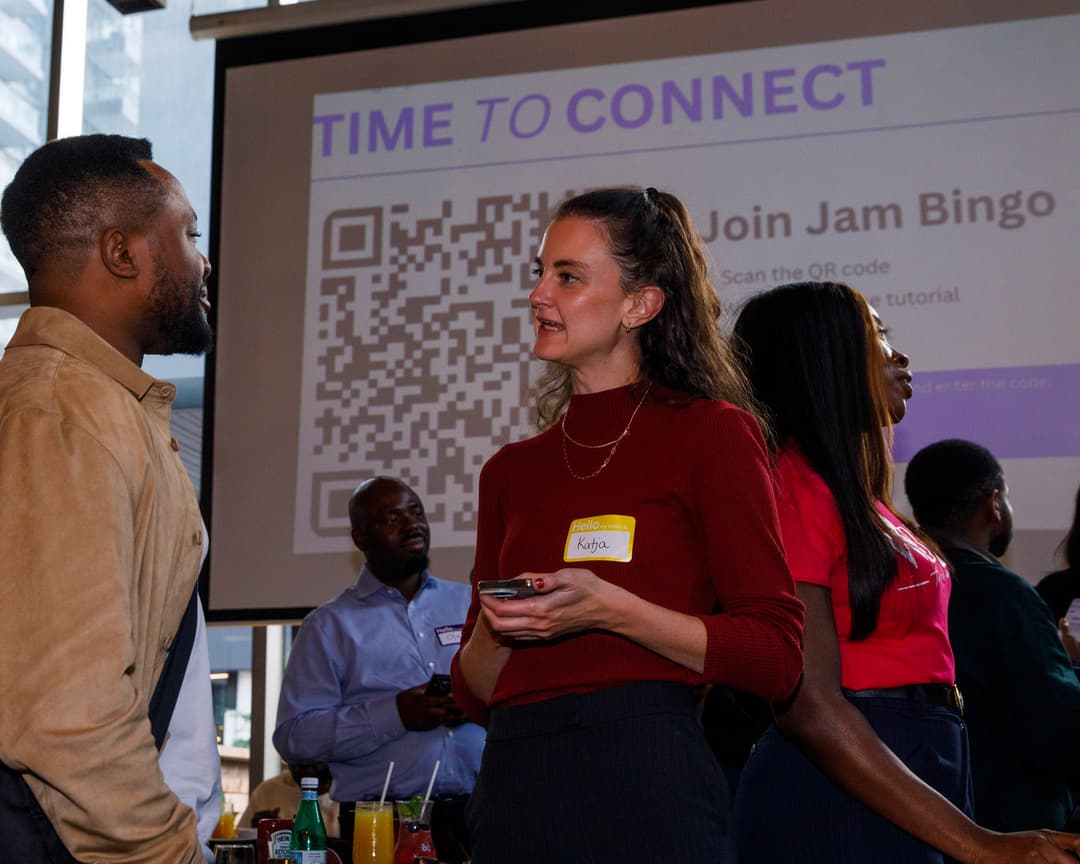
Before the dinner starts, display the QR code on a screen at the front of the room, print it on the menu card, or prop it up on each table. Ask everyone to scan with their phone camera as they take their seats.
- 3
Each attendee gets a series of conversation challenges and prompts designed to get people out of their usual circles — things like 'Find someone who has been in the company longer than you think,' 'Find someone who has a completely different morning routine to you,' or 'Find someone who has never been to the kind of restaurant you're eating in right now.'
- 4
Attendees move around the room between courses, approach people they don't usually talk to, and have a real conversation to complete each challenge. Finishing a challenge unlocks the next prompt.
- 5
The app runs the whole thing — no paper, no manual tracking, no facilitating required. Just a QR code and conversations.
- 6
The first person to complete all their challenges wins a prize. But the real goal is to make sure every person at the dinner has talked to at least five people outside their usual orbit before the main course arrives.
- 7
Before the dinner, set up your department work dinner game on the Icebreaker Bingo App. Mix prompts that get people out of their bubble ('Find someone who joined the department from a completely different industry') with fun ones ('Find someone who has a strong opinion about the bread basket') and personal ones ('Find someone who has been to the same city as you for reasons you'd never guess').
Scan To Join
Game Code: QW40PM
- 1
Scan to join
Attendees scan the event’s Jam Bingo QR code (or enter the game code). It runs in the phone’s browser—nothing to download.
- 2
Get a conversation prompt
Each person receives a conversation prompt on their phone, like a question to ask someone new.
- 3
Find someone and talk
They find someone who fits the prompt, have the conversation, then scan that person’s QR code (or enter their code) to unlock the next prompt.
- 4
Repeat and connect
Every connection is saved, and the leaderboard shows who met the most new people—perfect for prizes.
Run this during the arrival drinks and starter course — when people are still in 'social mode' and moving around. By the time the main course is served, you want everyone to have already broken the ice with at least three new people. The app makes that happen without you having to manage anything. Just set your prompts and let it run.
Everyone who completes all their challenges wins. First to finish gets a prize, but celebrate every completion.
Grand prize: a dinner-for-two voucher or a $50 restaurant gift card. Everyone who completes all challenges: a 'Great Connector' shoutout in the team group chat the next morning.
This is genuinely the best adult ice breaker for people who hate icebreakers. The app gives them a script: 'Hey, I have this challenge — can I ask you something?' That one line removes the 'what do I even say?' paralysis completely. And they can go at their own pace, in quiet one-on-one conversations, without any whole-table spotlight.
Compliment Menu
How to play
- 1
Before the dinner, print a 'compliment menu' for each person — styled like an actual restaurant menu but with categories instead of dishes. Categories: 'Something I noticed about your work this year,' 'A skill you have that I don't talk about enough,' 'Something you did that made my week easier,' and 'The thing about you that surprises people.'
- 2
During the starter course, each person fills out a compliment menu for the person sitting to their left — anonymously.
- 3
Menus are passed to the right so they go to the correct person.
- 4
Each person reads their compliment menu silently. They can choose to share one item aloud or keep it.
- 5
The table votes on which compliment was the most specific and unexpected — not the nicest, the most specific. That person wins the round.
- 6
Close by going around the table: each person shares one word about how they feel reading their menu.
Most work dinners have plenty of compliments, but they're vague — 'you do great work.' This game forces specificity. 'You stayed late to fix the server issue before the client call' lands completely differently than 'you're dedicated.' Specificity is what makes people feel actually seen.
Most specific and unexpected compliment, voted by the table.
A 'Most Seen' award — a small framed card with their best compliment printed on it. Or dessert is on the winner's honor.
Everything here is written, not spoken. Quiet folks participate fully through the menu. Sharing aloud is always optional — they can just nod and smile when theirs is read.
Dinner Debate (30 Seconds, No Prep)
How to play
- 1
Prepare a stack of debate topic cards — keep them light, work-adjacent, and slightly absurd. Examples: 'Meetings should have a maximum of four people.' 'Reply-all should be banned.' 'The best team building happens outside the office.' 'Open plan offices are a punishment.' 'Friday afternoon is not real work time.'
- 2
One person draws a card and reads it aloud. They have 30 seconds to argue FOR the statement, no matter what they actually think.
- 3
The person across from them has 30 seconds to argue AGAINST, also no matter what they actually think.
- 4
The rest of the table votes on who was more convincing — not who was right.
- 5
The winner draws the next card and picks their opponent. Losers become the voting panel.
- 6
The person who wins the most rounds earns the 'Table Advocate' title for the evening.
The 'argue a position you don't believe' rule is the key. It removes ego from the debate and makes it hilarious. You'll have the CEO arguing that all meetings should be abolished while the meeting-lover argues passionately that we need more of them. Pure chaos, pure connection.
Person who wins the most debate rounds as judged by the table.
A 'Devil's Advocate' badge, a small trophy made of a dinner roll (truly), or they get to make one real suggestion to the team without it being shot down immediately.
Quiet folks can be the 'voting panel' for several rounds before jumping in as a debater. The 30-second format with a timer is comforting — they know exactly when they're done. And arguing a position they don't believe removes the pressure of actually being right.
Three-Course Stories
How to play
- 1
Before the dinner, place three question cards under each plate — face down. Each card corresponds to a course: starter, main, dessert.
- 2
Card 1 (starter): a getting-to-know-you question. 'What's the most unexpected job you had before this one?' or 'What's a skill you have that has nothing to do with work?'
- 3
Card 2 (main): a going-deeper question. 'What's the best piece of advice you've ever ignored?' or 'What's something you changed your mind about in the last year?'
- 4
Card 3 (dessert): a forward-looking question. 'What's one thing you want this team to do differently next year?' or 'What's one thing you hope someone at this table remembers about tonight?'
- 5
Each course begins with everyone flipping their card simultaneously. They have 5 minutes of open table discussion — no turns, no structure, just conversation sparked by the card.
- 6
The facilitator closes each course by asking: 'Did anyone hear something surprising?' One person shares before the next course begins.
The genius of this one is timing — the questions get deeper as the meal goes on and people get more comfortable. By the time the dessert question hits, the table has already been talking for an hour. The 'changing your mind' question almost always produces the most unexpected answers. People reveal things they've never said out loud at work.
No competition — the win is the conversation. But the person whose dessert answer gets the most follow-up questions earns a 'Dinner MVP' title.
A 'Dinner MVP' card signed by the table, or the department commits to acting on whatever they raised in the dessert question.
The simultaneous card flip means no one is called on — it's open conversation, not a round-robin. Quiet folks can answer or listen as the mood takes them. And the card does the work of opening the conversation so they never have to.
Soundtrack Swap
How to play
- 1
Before the dinner, set up a shared playlist (Spotify, Apple Music, or YouTube). Display the link or QR code on each table.
- 2
Before the first course, everyone adds one song to the shared playlist — the song that best represents their current mood, their personality, or what they wish they could play at the office.
- 3
As the playlist shuffles through dinner, every time a song comes on, the person who added it raises their glass.
- 4
The table guesses whose song it is before they raise their glass. Correct guesses earn a point.
- 5
At the end of the night, the playlist stays live. The person whose song got the most 'I had no idea that was you' reactions wins.
- 6
The playlist becomes the department's official dinner playlist — updated at every future dinner.
Music is one of the fastest ways to learn something real about a person. When the head of data analytics raises their glass for a reggaeton track, everything changes. The 'guess whose it is' mechanic keeps people listening and paying attention all night — even when conversations drift.
Person whose song generated the most surprised reactions wins.
They become the official DJ for the next department dinner, a music streaming gift card, or a 'Hidden Depths' award.
Adding one song is a very low-ask form of self-expression. Quiet folks can participate fully without saying a word — their song speaks for them. And the guessing mechanic means the conversation comes to them rather than them having to start it.
Secret Dinner Roles
How to play
- 1
Before guests arrive, place a secret role card on each seat. Roles might include: 'The Curious One (you must ask at least four questions tonight that you genuinely don't know the answer to),' 'The Connector (you must introduce two people who haven't met before by the end of the night),' 'The Storyteller (every answer you give must include a personal anecdote — however brief),' 'The Devil's Advocate (if everyone agrees on something, you must find a different angle — politely),' 'The Encourager (notice when someone says something good and call it out by name).'
- 2
Roles are secret — no one tells anyone their role during the dinner.
- 3
At the end of the night, the group tries to guess who had which role.
- 4
Anyone who correctly guesses another person's role wins a point. Anyone whose role was NOT guessed wins two points — they played it perfectly.
- 5
The person with the most points wins.
This is one of those ice breaker games for work dinners that runs itself — you don't have to facilitate anything after handing out the cards. The roles quietly change how people show up all evening. The Encourager will make someone's night. The Connector will introduce two people who will email each other Monday morning. And the Devil's Advocate will make the conversation four times more interesting.
Most points from correctly guessing roles AND not having your own role guessed.
A 'Most Undercover' award for whoever played their role most seamlessly, or a bottle of wine for the table with the most correct guesses.
Assign roles that suit quieter personalities — 'The Curious One' or 'The Encourager' require listening and noticing, not performing. These roles let quiet folks contribute powerfully without having to dominate a conversation.
The Unrehearsed Toast
How to play
- 1
At dessert, announce that the dinner will close with toasts — but not from the usual people. Tonight, toasts come from whoever the dice selects.
- 2
Roll a die or flip a coin to select three people at random. Give each person 60 seconds to give a toast about the team, the department, or any specific person in the room.
- 3
The rule: no planning. Whatever comes out in 60 seconds is the toast. No index cards, no draft, no 'let me think about this.'
- 4
After each toast, the table responds with a single word — shouted all at once — about how that toast made them feel.
- 5
The person who receives the most heartfelt single-word reaction wins a 'Best Toast' honor.
- 6
Close by everyone raising their glass simultaneously and saying the same word: one word to describe this team, chosen by whoever spoke first that evening.
Unrehearsed toasts are almost always better than rehearsed ones. People say things they would never put in a speech. The 60-second limit forces honesty — there's no time for corporate language. And the single-word response from the table is unexpectedly moving. Try it once and you'll do it at every dinner.
Person whose toast generated the most emotional single-word reactions wins.
A 'Voice of the Table' card signed by everyone, or they pick where the next department dinner is held.
The randomness of selection means quiet folks might be called on — but the 60-second rule and the 'no planning' framing actually helps. There's no expectation of perfection. If they freeze, the group gently supports them. And they can always say: 'I'd rather pass my roll to someone else' — which is always an option.
How to Run Ice Breakers at a Department Work Dinner That People Actually Enjoy
- 01
Start the Icebreaker Bingo App before anyone sits down
Put the QR code on the table, the menu card, or the screen near the entrance. As people arrive and grab their first drink, they scan and start. The app gets everyone moving and talking before they've even found their seat. By the time the starter arrives, the ice is already broken. This is the single most effective thing you can do to kill the awkward arrival silence.
- 02
Use the meal structure as your game timer
The best department work dinner ice breakers work with the meal, not against it. Run Three-Course Stories across the whole dinner. Run Where in the World during drinks. Run the Unrehearsed Toast at dessert. The courses give you natural moments to start and stop — no one has to announce 'game time' awkwardly. It just flows.
- 03
Mix tables deliberately — don't let people choose their seats
Pre-assign seating with intention. Put one person from each team or project on each table. If your dinner has four tables of eight, make sure no table is all from the same department. This is the single biggest structural change you can make — and it works even without a single game. Add games on top and the mixing becomes natural rather than forced.
- 04
Run one high-energy game and one quiet game per hour
Alternate between active ice breaker games for work (like Dinner Debate or Story Dice, where people are laughing and responding fast) and quieter ones (like Compliment Menu or Three-Course Stories, where people reflect and write). After a loud game, conversation naturally continues on its own — you don't need to program every minute. Leave space for unstructured talking between games.
- 05
Assign one 'Table Host' per table
Recruit one person from each table ahead of time — someone natural and comfortable. Give them a one-page brief: the order of games, the rules, when to call time. They run the table's games so you don't have to manage four conversations at once. Table Hosts also make sure quieter colleagues are included without being put on the spot. Brief them 24 hours before — not the day of.
- 06
Close with something that doesn't feel like a game at all
The Unrehearsed Toast or the final 'one word' from Closing Circle are the best way to end a department work dinner. They signal that the structured part is over and the real connection is beginning. Never close with a competitive game — someone wins, someone loses, and the last feeling people take home is competitive rather than warm. End on shared reflection and everyone leaves feeling like the evening mattered.
Frequently Asked Questions
How many ice breaker games should we run at a 2-hour department work dinner?
Two to three games is the sweet spot for a department work dinner. Run the Icebreaker Bingo App during arrival drinks (20 minutes), then one table game during the starter (Story Dice or Where in the World, 15 minutes), let the main course be conversation-only, and close dessert with the Unrehearsed Toast (10 minutes). That's it. Easy and quick ice breakers work best when they leave room for natural conversation — don't fill every minute.
What if some people really don't want to play any games?
Completely fine — and honestly, expected. Announce at the start: 'We have a few optional things to help everyone get talking, but there's zero pressure to join.' The Icebreaker Bingo App is the most opt-in-friendly — people can complete as many or as few challenges as they like. Secret Dinner Roles are passive enough that resistant participants barely notice they're playing. And the Compliment Menu works even if someone just reads theirs quietly and says nothing. The best adult ice breakers have a built-in exit ramp.
How do we include people who are new to the team?
Seat new team members next to long-tenured colleagues intentionally. Then run games that reward not-knowing — like Assumption Swap, where the whole point is revealing that what everyone assumed about you is wrong. For the Icebreaker Bingo App, include prompts specifically for new people: 'Find someone who can tell you one thing that would have helped you in your first week here.' New people stop being invisible when the game is literally about them.
What if the dinner is for a large department — 50 or more people?
Scale to the room. For 50+ people, run the Icebreaker Bingo App (it handles any size easily), table-based games like Story Dice and Three-Course Stories (each table plays independently), and a closing whole-room game like Soundtrack Swap or the Unrehearsed Toast. Avoid games that require the whole room to go in one circle — they take too long and the back half loses interest. Keep it table-sized and let the app handle the cross-table mixing.
Do we need to buy anything special for these games?
Almost nothing. Story Dice needs regular dice and printed word slips. Where in the World needs a printed world map (free to find online). Compliment Menus need a simple printed card you design in 10 minutes. The Icebreaker Bingo App just needs a QR code. Everything else — cards, pens, sticky notes — you probably have at the office already. The most expensive thing about a great department work dinner ice breaker is the dinner itself.
What's the best ice breaker to run if we only have time for one?
The Icebreaker Bingo App, without question. It runs during the arrival window so it doesn't eat into dinner time, it works for any group size, and it handles introverts and extroverts equally well. The app gives everyone a reason to approach someone new with a clear script — no awkward cold starts. If you only do one thing at your department work dinner to get people out of their usual circles, make it that.
More Icebreaker Collections
10 Ice Breaker Games for Your Summer Social
Summer Social · 10 games
Ice Breaker Games for Law Firm General Meeting
Law Firm General Meeting · 10 games
10 Ice Breaker Games for Chamber of Commerce New Member Orientation
Chamber of Commerce New Member Orientation · 10 games
10 Unique Icebreaker Games for New Student Engagement
New Student Orientation & Welcome Events · 10 games
10 Easy & No-Prep Interactive Networking Games for Professionals
Professional Networking Event · 10 games
11 First-Time Coming Together Ice Breaker Games for Corporate Events
First-Time Coming Together Corporate Event · 11 games