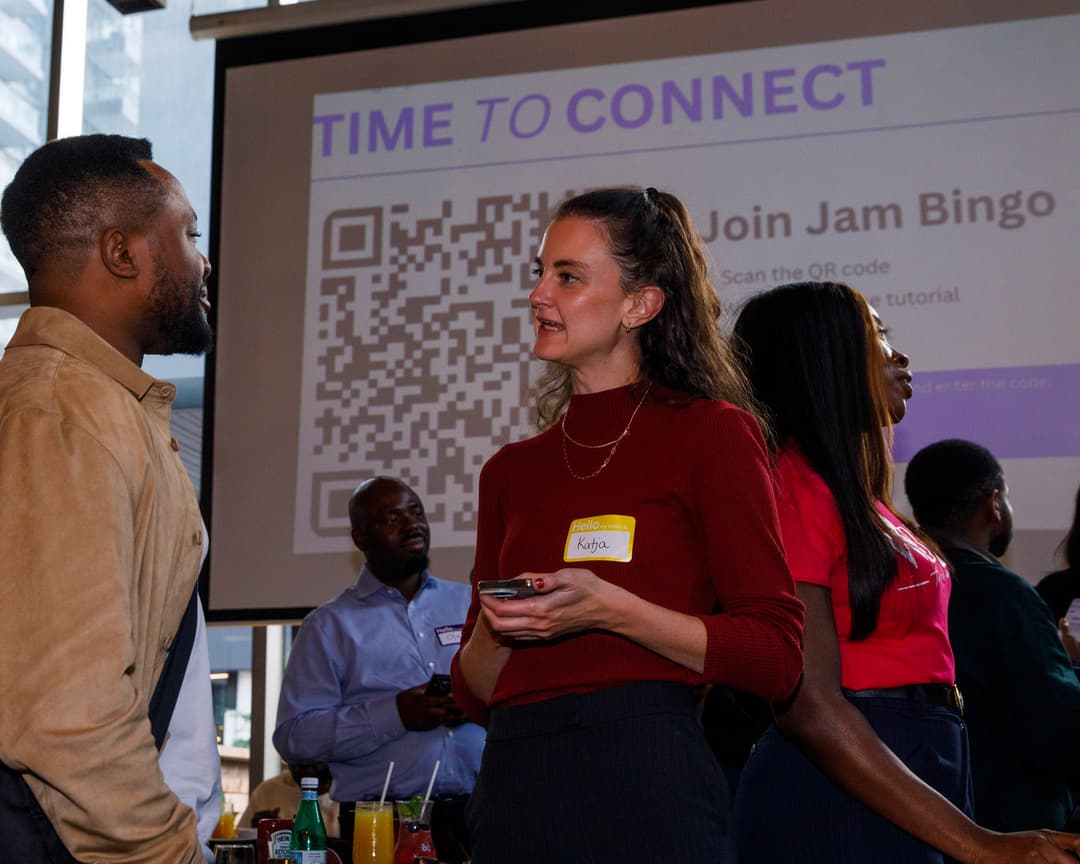

Why Does Networking at Events Feel So Awkward?
Most people want to connect — they just do not know how to start.
Even at events designed for networking, most attendees spend the first 20 minutes hovering near the drinks table, checking their phones, or talking to the one person they already know. It is not a personality problem — it is a structure problem. People need a reason to approach a stranger, and Networking Bingo gives them exactly that.
Bingo reframes the ask — instead of 'introduce yourself,' it becomes 'find someone who.'
That shift is everything. A mission is less intimidating than an open-ended social expectation. Attendees stop thinking about what to say and start thinking about who to find — and real conversations happen naturally in the process.
What Is Networking Bingo and How Does It Work?
It is human bingo — each square is a prompt that requires talking to someone new.
Each attendee gets a bingo card filled with prompts like 'Find someone who has lived in another country' or 'Challenge someone to name three things you have in common in under a minute.' To complete a square, they have to find and talk to a real person in the room. The goal is a full row — or a full card, depending on your time and group size.
- The format works because it solves three common event problems at once:
- It gives introverts a concrete task instead of an open social expectation.
- It distributes energy across the whole room rather than clustering conversation in one corner.
- It creates memorable shared moments that people reference in conversations long after the game ends.
How Do You Set Up Networking Bingo at Your Event?
Setup takes under 10 minutes — the hard part is writing good prompts.
Here is the full setup process, whether you are running it on paper or digitally:
- Step 1 — Write your prompts.
- Aim for 9 to 25 prompts depending on your card size (3x3 or 5x5).
- Mix easy prompts (find someone wearing glasses) with deeper ones (find someone who changed careers).
- Tailor at least half the prompts to your specific event type or audience — generic cards get less engagement.
- Step 2 — Choose your format.
- Paper cards work fine for groups under 30 and require no technology.
- For groups over 50 people, digital bingo cards eliminate the paper printing overhead.
- For hybrid events, digital is the only format that works equally well for in-person and remote attendees.
- Step 3 — Display and distribute.
- For digital bingo: project the QR code on a screen or place it on a sign at the entrance so attendees can scan as they arrive.
- For paper: place cards face-down at seats or hand them out at check-in with a brief instruction card.
- Do not explain the game before attendees have the card in hand — it lands better when they can follow along.
- Step 4 — Make the announcement.
- Keep the announcement to 60 seconds or less.
- State the goal, the time limit, and the prizes (if you'll have prizes).
- Explicitly tell attendees they have permission to approach anyone in the room — this one line removes more friction than anything else you can do.
Script: A 60-second announcement you can use directly
- Before we get started, we are kicking things off with a networking game.
- Everyone grab a card — or scan the QR code on the screen.
- Your goal is to find people in the room who match each square. To check off a square, you have to actually talk to that person — a wave does not count.
- First person to complete a full row wins. You have got 20 minutes. Go.
When During Your Event Should You Run Networking Bingo?
The opening 20 minutes is the highest-leverage window.
Timing matters more than most hosts realize. Running bingo at the wrong point in your event produces noticeably worse results:
- Best times to run it:
- During the opening mixer, before any formal programming — attendees have no excuse not to participate and the energy is naturally high.
- After a meal or break, when conversation has naturally stalled and people need a re-energizer.
- At the start of a multi-day conference on day two, when attendees have seen each other but have not yet introduced themselves.
- Times to avoid:
- Immediately after a long keynote or panel — attendees are mentally tired and will rush through prompts.
- As the last activity of the night — low energy means low engagement.
- During a meal, unless it is a dedicated activity with cleared tables and clear instructions.
What Are Good Networking Bingo Prompts for Events?
The best prompts create a conversation, not just a yes-or-no answer.
Avoid prompts that can be answered with a nod. The goal is to get attendees talking for at least 30 seconds per square. Here are ready-to-use prompts organized by type:
Find someone who...
- Is standing or sitting alone — introduce yourself and ask what brought them out tonight.
- Has lived in more than two cities — ask which was their favorite and why.
- Works in a completely different industry than you — find out what crossover there might be.
- Has attended this event before — ask what keeps them coming back.
- Has met more than five new people tonight — ask them to introduce you to one.
Challenge someone to...
- Name three things you both have in common in under one minute.
- Introduce you to someone else they just met tonight.
- Pitch what they do in exactly ten words — no more, no less.
- Name a skill they have that most people in the room would not expect.
- Tell you the most useful thing they have learned this year.
Ask someone to...
- Share the best professional advice they have ever received.
- Tell you about a project they are currently excited about.
- Recommend one book, podcast, or resource that changed how they work.
- Describe their career path in three words.
- Tell you about the best trip they have ever taken.
For a deeper library of prompts, see the full list of 67 Human Bingo Questions.
How Do You Write Networking Bingo Prompts for a Specific Audience?
Generic prompts produce generic conversations — tailor them to your crowd.
The single biggest upgrade you can make to any networking bingo card is replacing generic prompts with ones that reflect your specific event, industry, or community. Here is how:
- For professional conferences:
- Reference the event theme or keynote topic directly in at least two prompts.
- Include prompts about career milestones, industry challenges, or role-specific experiences.
- Example: 'Find someone who has spoken at a conference before — ask them for one tip.'
- For community and social events:
- Use prompts that reveal personality and shared interests rather than professional background.
- Include local references — neighborhoods, restaurants, landmarks — that spark recognition.
- Example: 'Find someone who has eaten at a restaurant on your personal must-try list.'
- For team-building events:
- Focus prompts on shared work experiences, inside references, or company milestones.
- Include at least one prompt that requires collaboration rather than just conversation.
- Example: 'Find someone from a different department and agree on one thing you could do better together.'
What Types of Events Work Best for Networking Bingo?
Any event where strangers are expected to connect is a good candidate.
- Networking bingo has been used successfully at:
- Professional conferences and summits — especially during opening mixers or lunch breaks.
- Corporate team-building days — particularly for cross-departmental or post-merger events.
- University and college orientations — to help new students meet peers outside their immediate program.
- Community socials and speed friending events — where the goal is broad social connection rather than professional networking.
- Dating mixers and singles events — with prompts adapted to personal rather than professional discovery.
- Classroom settings — as a low-stakes first-day activity that helps students learn each other's names and backgrounds.
Should You Run Networking Bingo on Paper or Digitally?
Paper works for small groups. Digital scales to any size without the logistics.
- When paper makes sense:
- Groups of 30 or fewer where printing is simple and tech setup feels like overkill.
- Events where the tactile feel of a physical card adds to the atmosphere.
- Situations where reliable Wi-Fi or phone access cannot be guaranteed.
- When digital makes more sense:
- Groups over 30 where printing, distributing, and collecting cards becomes a logistical burden.
- Hybrid events where some attendees are remote and need equal access to the activity.
- When you want real-time participation data to see who is engaging and who needs encouragement.
For digital networking bingo, Jam Bingo lets you build a custom card, generate a QR code, and have attendees playing within minutes.
How Do You Make Sure Networking Bingo Actually Leads to Real Connections?
The game starts the conversation — your job is to make it easy to continue.
- Practical ways to extend the connections bingo creates:
- Close the activity with a 2-minute group share — ask three attendees to name the most interesting person they met and why. This publicly reinforces that connections were made and encourages follow-up.
- For professional events, encourage attendees to connect on LinkedIn immediately after finding a match rather than waiting until they get home.
- At multi-session events, reference the bingo conversations in later programming — 'Turn to someone you met during bingo earlier and share your reaction to that last talk.'
- If you collect digital participation data, follow up after the event with a summary of who connected with whom to reinforce the relationships formed.