Gamification Ideas to Make Networking Interactive
Give people a reason to mingle organically with people they do not already know (without it feeling awkward or cringey)
Most networking events have a structural problem. You put a room full of professionals together, and expect them to... figure it out.
Some people are great at that. Most are not.

With a large group of 100, 400, 700, or even 1,000 people, it can be extremely difficult.
Event gamification solves this by replacing the open-ended pressure of 'go network' with a clear, interactive activities.
The interactive activity removes the awkward feeling of networking. It creates space for real and meaningful conversations.
What Does It Mean to Gamify a Networking Event?
It means adding a goal, a structure, and a little friendly competition to what would otherwise be free mingling time.
Event gamification does not mean turning your professional mixer into a game show. It means giving attendees a lightweight framework that makes starting conversations easier and more natural.
The most effective gamified networking events share three things:
- A clear objective people can understand in under ten seconds.
- A mechanic that requires talking to someone new, not just with familiar faces.
- A low-pressure environment where participation feels fun.
When those three things are in place, you stop getting a room of people staring at their phones and start getting a room full of actual conversations.
Top Three Best Interactive Networking Activities:
What are the best networking activities to help get people out of their bubble?
Here are the formats that work best for professional networking events, from department kick-offs to partner showcases.
1. Human Bingo
Human Bingo is one of the oldest networking games out there for a reason. Each person gets a bingo card with prompts in each square, like 'find someone who has lived in more than one country' or 'find someone who has pitched an investor.' The goal is to complete the card by having real conversations.
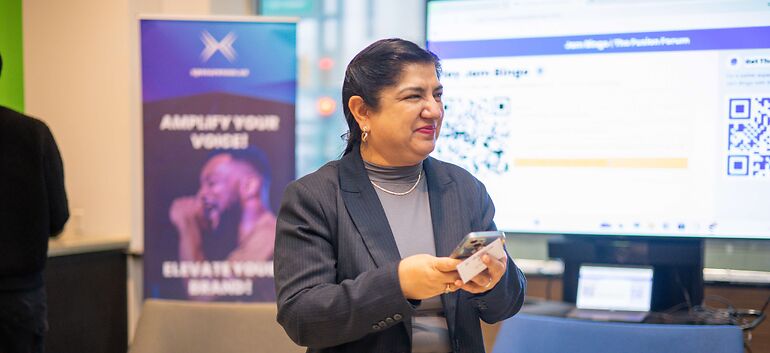
For large events (100+ people), Jam Bingo, takes this concept and makes it run on people's phones. No printing, no paper cards that get lost.
2. Speed Networking with a Twist
Traditional speed networking is pairs of people rotating every few minutes. That baseline works. But it gets more interesting when you add a specific prompt to each round.
Round one: tell the other person the most surprising thing about your career path. Round two: share the best piece of advice you have ever received. Round three: what would you be doing if you were not in your current role.
People leave speed networking with actual memories of the people they met, not just a stack of business cards they will never look at.
3. The Bounty Game
When guests arrive, each person gets a slip of paper with someone else's name on it. Their mission for the event is to find that person and tap them on the shoulder.
Here is the catch: nobody knows anyone yet. So you have to actually talk to people to figure out who is who.
Once you find your target, you collect their slip and inherit their target. The person with the most slips at the end of the night wins.
It sounds simple because it is. But it works extremely well for getting people to move around the room and approach strangers they would never have talked to otherwise.
4. Jam Bingo - Incentivize Networking for Large Groups (100+ People)
You have a large group of 100+ people and are looking for a simple, organic way to encourage attendees to interact with one another.
The attendees are coming from different organizations, departments, cities, schools, and other backgrounds.
Since not everyone knows each other, you want to encourage people to step outside their usual circles.
Jam Bingo is especially for large groups of 100 or more people, and it incentivizes unaquainted attendees to get to know each other, encouraging meaningful conversations instead of surface-level networking. See how Jam Bingo works!
Tips for Facilitating Networking Activities
The opening window is the highest-leverage moment in your event.
Timing matters more than most hosts realize. The first hour of any networking event is when energy is lowest and awkwardness is highest. People are arriving, getting their bearings, and defaulting to whoever they came with.
That is exactly when a networking activity pays the biggest dividend.
Run your gamified activity during that opening window and you accomplish two things at once. You give early arrivals something to do while you wait for the room to fill. And you break social clumps before they form.
By the time the main programming starts, people have already met new people. The room feels warm. The rest of the event runs easier.
What Makes a Good Networking Game?
It needs to start real conversations, not just get people moving.
Not all networking games are equal. Some get people moving but produce conversations that go nowhere. The game ends and nobody remembers who they talked to.
A good networking game has a few things going for it:
- The prompts require a real answer. 'Find someone who has failed at something and learned from it' is better than 'find someone who has a cat.'
- The mechanic gets people across the room, not just talking to whoever is standing next to them.
- There is a natural conversation hook built in. The prompt does the introduction work so neither person has to figure out how to start.
When the prompt is good, the conversation that follows is good. And a good conversation is what turns a networking event contact into an actual professional relationship.
How Do You Keep the Energy Up After the Game Ends?
Event gamification is just the starting point.
Once the game has broken the ice, you can keep the energy moving. A few things that help:
- Announce a winner or share a highlight from the networking game. It gives people one more shared moment to laugh about.
- Introduce people who should know each other. You know your guest list. Play matchmaker.
- Ask the room a question from the front. It refocuses energy and reminds everyone they are part of the same group.
The goal is a room where people feel connected.