
Work events are awkward. Why?
Because professional settings add a layer of social pressure that most icebreakers are not built to handle.

When you put people from the same company or industry in a room together, something weird happens. They default to talking about work. They gravitate toward the colleagues they already know. They spend the first twenty minutes on their phone waiting for someone else to make the first move.
The problem is not the people. The problem is the format. Free mingling at a work networking event almost never produces the connections you are hoping for.
Ice breaking games fix that. A well-designed icebreaker gives every person in the room a specific reason to walk up to someone they have never talked to before. It removes the social guesswork and replaces it with structure. And when the structure is good, the conversations that follow feel genuine instead of forced.
Here are 4 steps to planning ice breaking games for a work networking event that actually deliver on that promise.
Step 1: Pick the right game
Work networking events have unique constraints. Your icebreaker needs to respect them.
Not every ice breaking game works in a professional context. Some activities are too silly for a room full of colleagues who have a reporting relationship with each other. Some require physical contact that would make people uncomfortable.
A good ice breaking game for a work networking event needs to clear four bars:
- Professionally appropriate. It should feel fun without making anyone feel exposed or embarrassed in front of coworkers or industry peers.
- Scalable. Whether you have 30 people or 150, the game should work the same way.
- Self-directed. It should not require a host to manage every interaction. People at a work event are adults who can follow a simple prompt.
- Conversation-starting. The point is not to play a game. The point is to give people a reason to have a real conversation with someone they do not know yet.
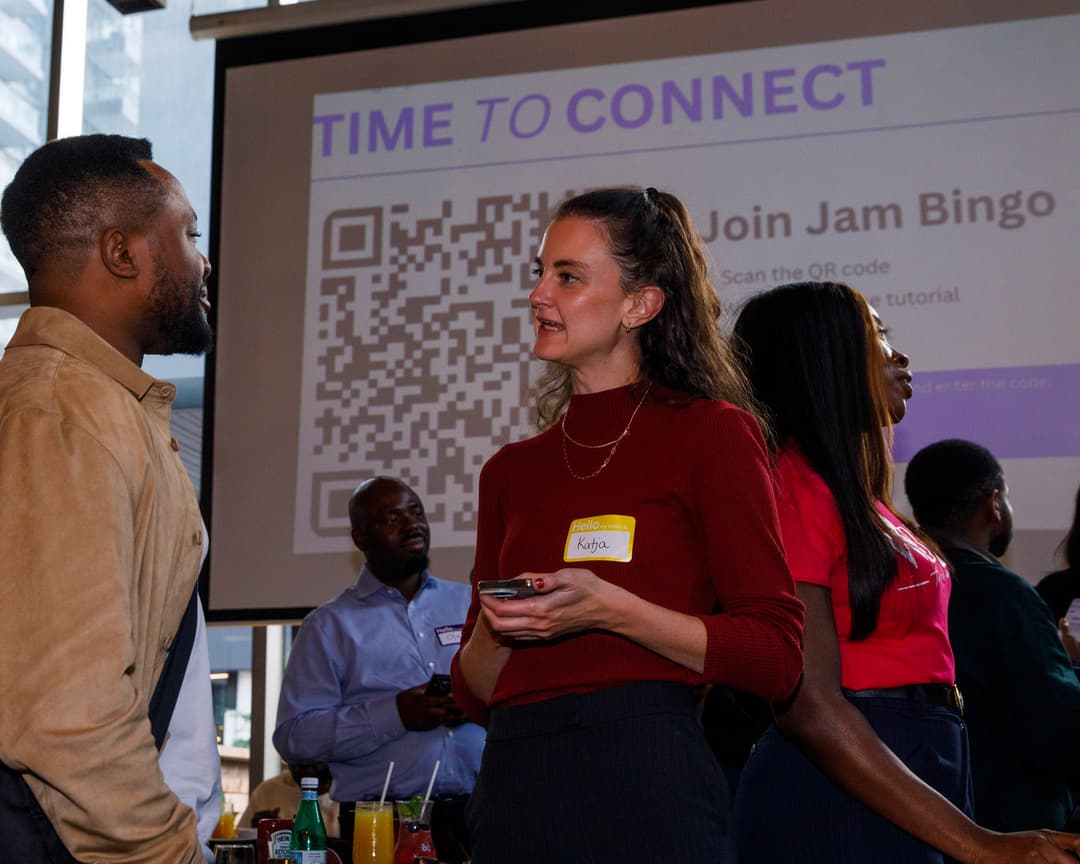
Jam Bingo was built with exactly these constraints in mind. It is a digital get-to-know-you game where attendees scan a QR code, receive a bingo card of conversation prompts on their phone, and go find real people in the room who match each one.
Every prompt is a conversation opener. Nobody is put on the spot. Nobody has to perform in front of the group. And the game runs itself so you can focus on hosting instead of managing an activity.
Step 2: Write icebreaker prompts that work
Generic prompts produce generic conversations. Tailor them to your crowd and your goal.
This is the step that separates a good ice breaking game from a great one.
For a work networking event, your prompts should do two things at once. They should be easy to find in the room, meaning enough people will match them that nobody gets stuck. And they should open a door to a longer conversation, not just a yes or no answer.
Here is the difference in practice. A weak prompt: 'Find someone who drinks coffee.' Easy to find. Goes nowhere. A strong prompt: 'Find someone who has switched industries at least once.' Takes a little more searching. Leads to a real story.
For a work networking event specifically, prompts that tend to work well include:
- Find someone who works in a completely different department than you.
- Find someone who has been at the company less than one year.
- Find someone who started their career in a different city.
- Find someone who has presented to a room of more than 50 people.
- Find someone who learned a new skill entirely on their own in the last year.
- Find someone whose job title you could not have guessed when you first met them.
With Jam Bingo, you can build your own prompt set from scratch or start from a template designed for professional events. Either way, the prompts live on the bingo card and every attendee gets them the moment they scan the QR code.
Step 3: Set it up right
A complicated setup kills participation before the game even starts.
Here is something that does not get talked about enough when it comes to ice breaking games for work networking events: the logistics matter as much as the game itself.
People at a professional event are not going to troubleshoot a broken signup form or wait for someone to hand them a printed card. If the barrier to entry is more than thirty seconds, a large chunk of your room will simply not bother.
Before your event, sort out these four things:
- How will people join? The answer should be: scan a QR code and that is it. No app download. No account creation. No registration form.
- Where will the QR code be displayed? For a standing cocktail-style event, a large screen or a printed A2 poster works well. For a seated dinner format, a small card at each place setting is better.
- When will you announce the game? Announce it once when the room is full and energy is high. Keep the explanation under 60 seconds. One sentence on what to do, one sentence on how to win.
- What is the prize? Even a small reward changes the dynamic at a work event. A gift card, a bottle of wine, or a nice experience voucher is enough to make the finish line feel worth chasing.
That matters a lot at a work networking event where you are already managing speakers, catering, AV, and a hundred other things. You want an ice breaking game that runs without you, not one that needs a babysitter.
Step 4: Time it and close it well
When you run the game and how you end it shapes how the whole evening feels.
Timing is where most people planning ice breaking games for work events go wrong. They either run the game too early before half the room has arrived, or too late when people are already deep in conversations and do not want to be interrupted.
The best window for a work networking event icebreaker is during the first 30 minutes after the room reaches critical mass. That is the moment when people are present, energy is still high, and nobody has locked into a corner conversation yet.
Give the game 20 to 25 minutes to run. That is enough time for most people to complete their card and have several real conversations, but short enough that the energy does not trail off before anyone finishes.
When you close the game, do it with intention. Bring the winner to the front if you can. Have them share one person they met and what they learned about them. That sixty-second moment reframes the whole activity. It reminds the room that the point was not to win a bingo card. The point was to meet someone worth knowing.
Then hand out the prize and transition straight into the next part of your program. The conversations that started during the ice breaking game will keep going on their own. You just need to give them a clean launch.
What makes work events different?
The social stakes are higher, so the icebreaker needs to be lower pressure.
This is worth saying directly. Ice breaking games at a work networking event carry a different kind of weight than games at a wedding or a casual social gathering.
People are aware they are being seen by colleagues, managers, or industry contacts. They are calibrating how they come across. That awareness makes them more cautious, not less.
The best ice breaking games for work reduce that pressure instead of adding to it. They give people something to do together instead of asking them to perform in front of everyone. They create a shared experience that becomes a reference point for conversations later in the evening.
That is what Jam Bingo does well. The prompts give people permission to approach someone new without it feeling like a cold call. The game gives them something to talk about. And because everyone is playing at the same time, no one feels singled out.
The 4-step recap
Everything you need in one place before your event.
- Pick a game that is professionally appropriate, self-directed, scalable, and built to start real conversations.
- Write or choose prompts that are specific to your group and lead somewhere beyond a yes or no answer.
- Nail the logistics before the day: how people join, where the QR code goes, when you announce it, and what the prize is.
- Run it in the first 30 minutes after the room is full, give it 20 to 25 minutes, and close it with intention.
Ice breaking games for work networking events do not have to be cringe. They just have to be designed for the actual context. When they are, they become the part of the night that people remember and talk about afterward.