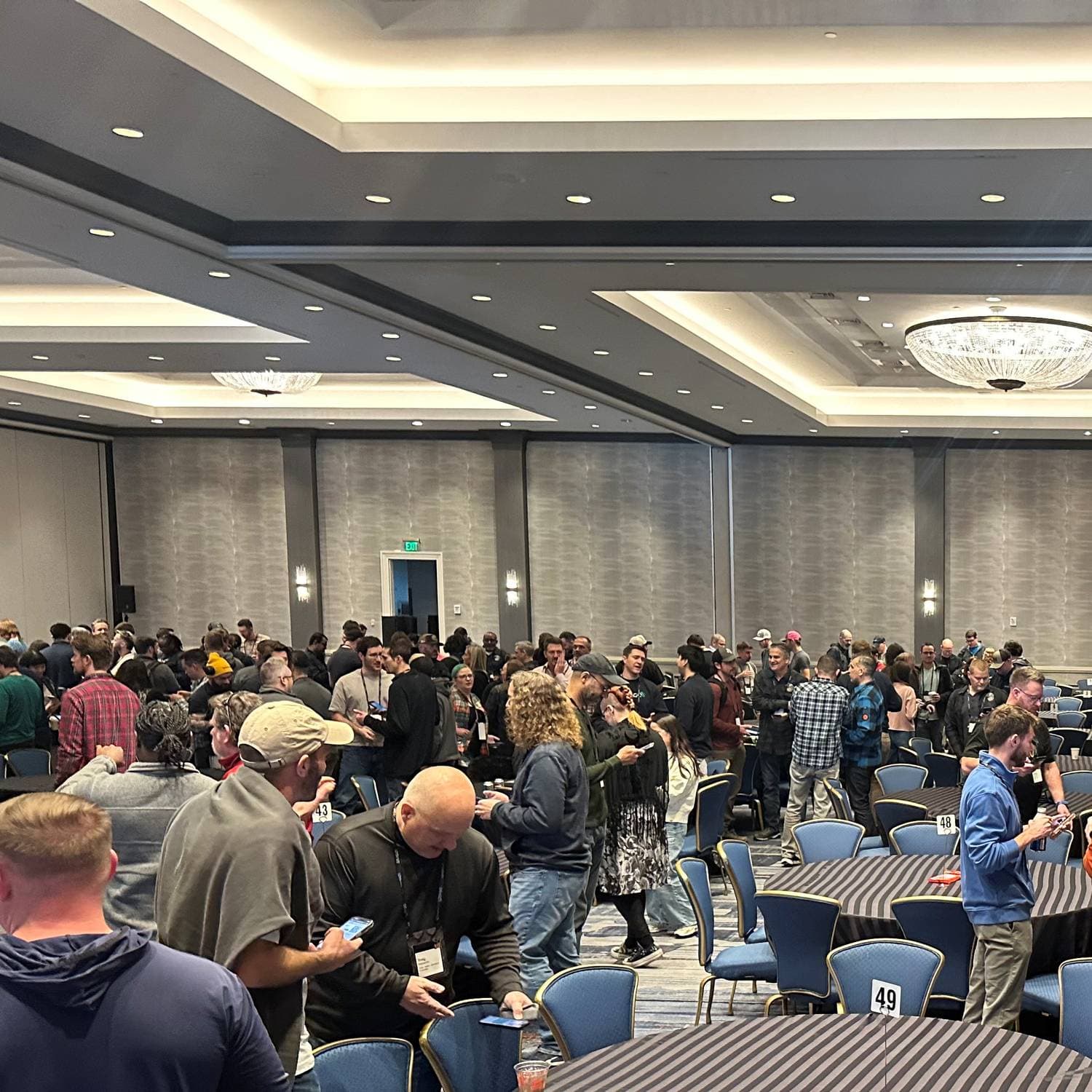
Big group. Now what?
Most icebreakers are designed for small rooms. Big groups need a different approach entirely.
Running an ice breaker for a big group is not just the same thing at a larger scale. The dynamics are completely different.
With 15 people, you can do a round of introductions and it feels warm. With 80 people, that same activity takes 45 minutes, kills the energy in the room, and half the group forgets who spoke by the time it is over.
What works for a small team does not work for a conference, a company all-hands, a school event, or a big celebration. You need an activity that is built for scale from the start.
This guide walks you through every step of organizing an ice breaker for a big group. What to pick, how to set it up, how to get everyone actually involved, and how to make it feel exciting instead of forced.
Step 1: Pick the right activity
Not every icebreaker scales. Choose one that is built for a crowd.
The first thing you need to do when organizing an ice breaker for a big group is throw out the activities that only work for small teams. That means no going around the circle, no two truths and a lie with 100 people, and no activities that require everyone to be quiet and listen to one person at a time.
A good ice breaker for a big group has four things going for it:
- It runs simultaneously. Everyone is doing something at the same time, not waiting for their turn.
- It gets people moving. Sitting at a table and answering a question is not an icebreaker. It is a meeting.
- It gives people a reason to talk to someone they do not know yet.
- It works without a host managing every moment of it.
1. The Easy Large Group Ice Breaker (100+ people)
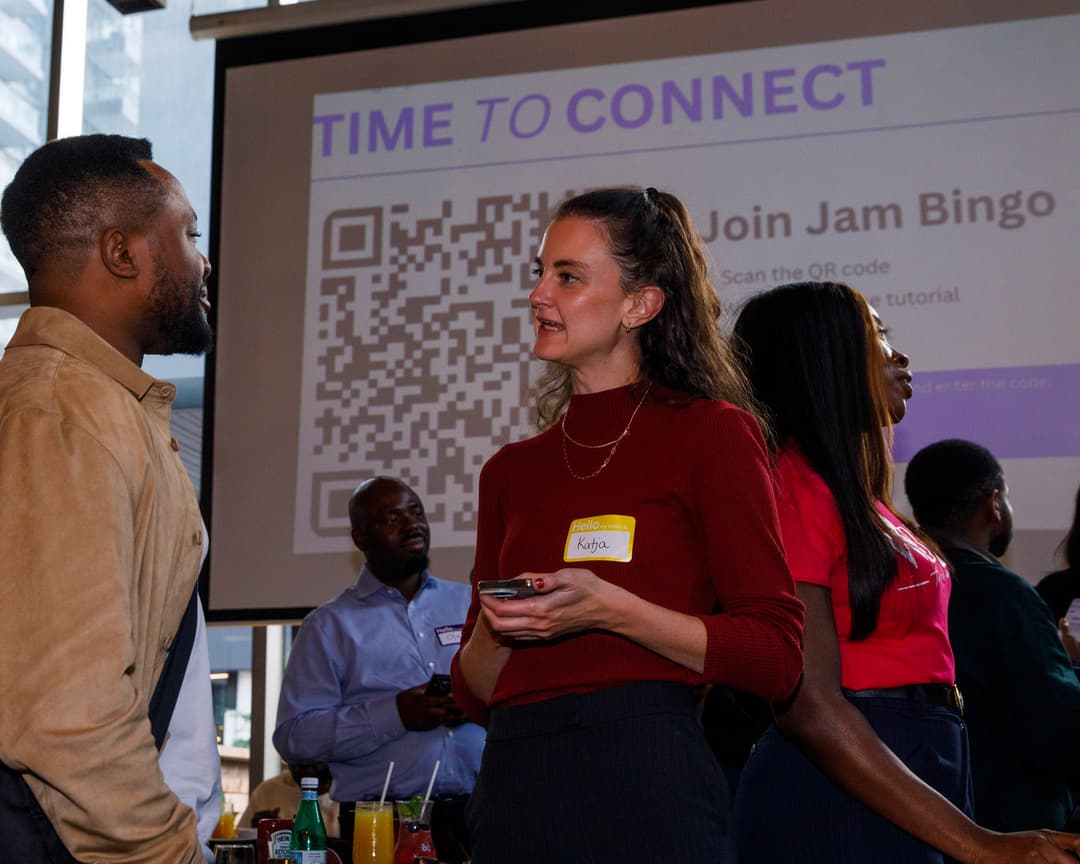
Jam Bingo is an easy large group ice breaker that incentivizes people to interact and talk with other people outside of their bubble. At a company event, this could mean people talking and interacting with people in other teams, departments (and other city/countries).
Every single person in the room is playing at the same time. There is no waiting, no taking turns, and no one person running the whole show.
Guests scan a QR code on their phone, get challenges & prompts to go find real people in the room. The challenges/prompts get people interacting with each other. The game runs itself.
Step 2: Set a clear goal
Know what you want people to walk away with before you start planning.
Before you can organize the right ice breaker for a big group, you need to know what you are actually trying to accomplish. The goal shapes everything else.
Are you trying to get people from different departments to meet each other? Are you welcoming a large group of new hires? Are you hosting a community event where nobody knows anyone? Are you kicking off a conference and want the energy to be high before the first session?
Each of those is a different goal and the icebreaker should be designed around it.
Step 3: Design the prompts
The prompts are the whole game. Get them right.
This is the step most people skip when they plan an ice breaker for a big group. They pick an activity and throw generic questions at it. That is where the energy dies.
Prompts for a large group icebreaker need to do two things at once. They need to be easy enough that anyone can answer them, and interesting enough that the answer leads somewhere. A prompt like 'find someone who is left-handed' is easy but goes nowhere. A prompt like 'find someone who has lived in more than one country' opens a real conversation.
Here is a framework for writing prompts that work for a big group:
- Make them findable. There should be enough people in the room who match the prompt that it does not take forever to complete.
- Make them specific enough to spark a follow-up question. The best prompts answer one thing and raise another.
- Mix light and meaningful. Some prompts can be fun and silly. Others can be more thoughtful. The combination keeps the energy varied.
- Tie some prompts to the event. If there is a theme, a cause, or a shared context, weave it in.
Step 4: Plan the logistics
Logistics sink icebreakers. Remove every friction point before the day.
Running an ice breaker for a big group has one enemy: complexity. The more steps a guest has to take to start playing, the more people you lose before the game even begins.
Here is what you need to sort out before the day:
- How will people find out about the game? Announce it when everyone is in the room. Keep the explanation under 60 seconds. One sentence on what to do, one sentence on how to win.
- How will they join? The join method needs to be instant. If it requires a download, an account, or more than two taps, you will lose half your group before they start.
- Where will you display the QR code? For a big group, you want it visible from anywhere in the room. A screen at the front works. Table cards work for seated events. A poster near the entrance works for arrival activities.
- Who calls the winner? Decide ahead of time how you will know when someone finishes and how you will announce it. This does not need to be complicated but it needs to be planned.
Jam Bingo is built to remove every one of those friction points. Guests scan one QR code. No download. No account. They are in the game in seconds. The host does not have to manage anything once it is live.
For a big group that is especially important. You do not want to be troubleshooting a game while also managing 80 people and a full event program.
Step 5: Time it right
When you run the icebreaker matters as much as what you run.
Timing is one of the most underrated parts of organizing an ice breaker for a big group. Run it too early and people are still arriving. Run it too late and the room has already split into cliques.
The best window for a large group icebreaker is usually one of these three moments:
- Right after the room is full but before the official program starts. This is the sweet spot. People are present, energy is still high, and you have a natural reason to kick things off.
- During a break between sessions. If you are running a full-day event or conference, a mid-event icebreaker during lunch or a break gets people up and moving again instead of checking their phones.
- At the very start of a mingling period. If your event has a dedicated networking or social window, launch the game at the beginning of that window to give people a structured reason to move around.
For a big group, 20 to 30 minutes is usually the right length. Long enough that people have time to complete their card and actually have conversations. Short enough that the energy does not drop off before anyone finishes.
Step 6: Get everyone in
The hardest part of a big group icebreaker is getting 100% participation.
Here is the honest reality of running an ice breaker for a big group. Some people will jump in immediately. Some people will hang back and wait to see what everyone else does. Some people will decide it is not for them and quietly opt out.
Your job is to design the activity so that opting out feels like the odd choice, not opting in.
A few things that help:
- Make the announcement from the front of the room with genuine energy. If it sounds like a chore when you introduce it, it will feel like one.
- Have a prize for the winner. Even a small reward changes the dynamic. People who were on the fence suddenly have a reason to play.
- Set a time limit out loud. Telling the group they have 25 minutes to complete their card creates urgency. Urgency gets people moving.
- Seed a few enthusiastic players. If you have colleagues or friends who know about the game in advance, ask them to start immediately and visibly. When people see others playing, they join.
Step 7: Close with energy
How you end the game sets the tone for the rest of the event.
Most people plan the start of their icebreaker and forget about the ending. That is a mistake. The close of an ice breaker for a big group is a moment you can use.
You can hand out prizes, acknowledge the whole group. Something like: 'If you talked to at least five people you had never met before tonight, that is exactly what this was for.' That reframe matters. It tells people that just by playing, they did something worth doing.
Then move straight into the next part of your program while the energy is still high. The worst thing you can do after a successful icebreaker is let the room go quiet.
The full checklist
Everything you need to run a large group icebreaker without a hitch.
- Pick an activity that runs simultaneously for everyone, not one person at a time.
- Set a clear goal for what you want guests to walk away with.
- Write or choose prompts that are findable, specific, and tied to your event theme.
- Sort out your logistics in advance: how people join, where the QR code goes, and who calls the winner.
- Time the icebreaker for the moment when the room is full but the program has not started.
- Use a prize, a time limit, and a confident announcement to pull everyone in.
- Close the game with energy and transition straight into the next part of your program.
Running an ice breaker for a big group does not have to be stressful. With the right activity and a bit of prep, it becomes the moment your event actually comes alive.