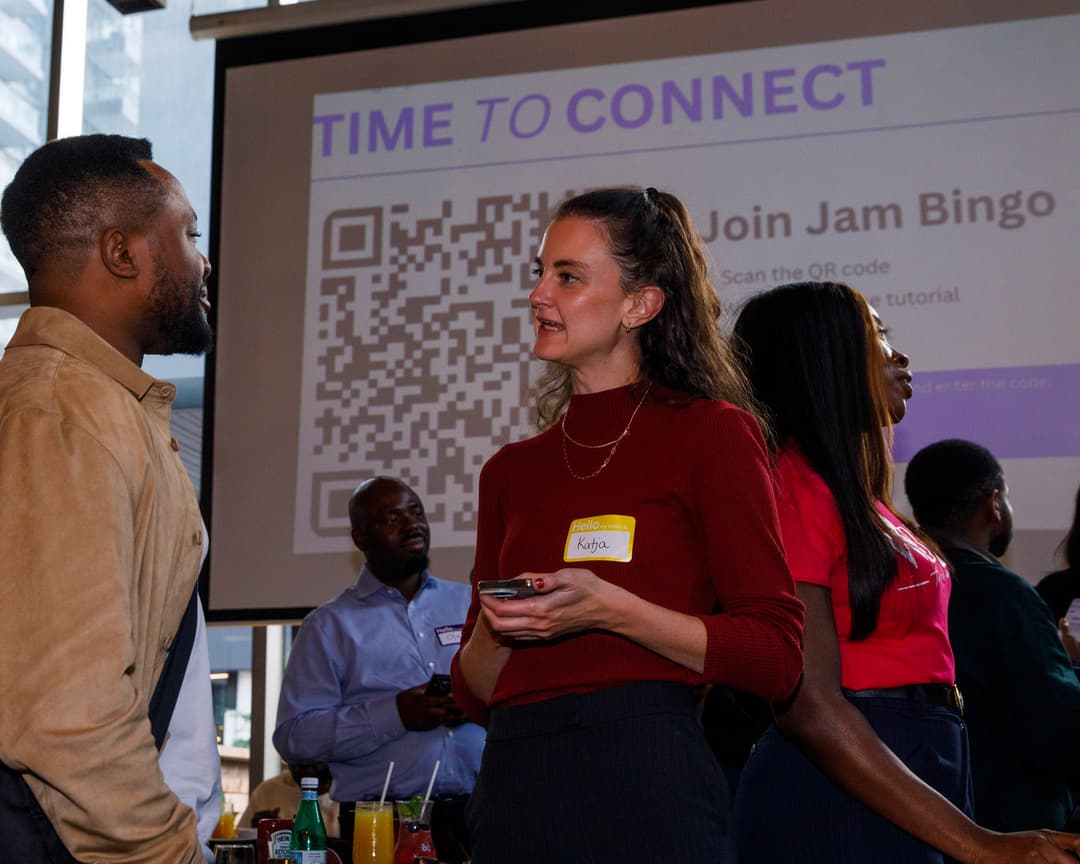
7 Best Interactive Networking Event Games for Larger Groups
Ice Breaking Networking Activity for a Larger Group
We're ranking the top 7 informal networking ice breaker activities using these three criteria:
- Easy for you to set up (no-prep)
- Easy for people to understand
- Easy for people to play
Having a large group (100+ people) where not everyone knows each other can be awkward and daunting for new and introverted people in the room.
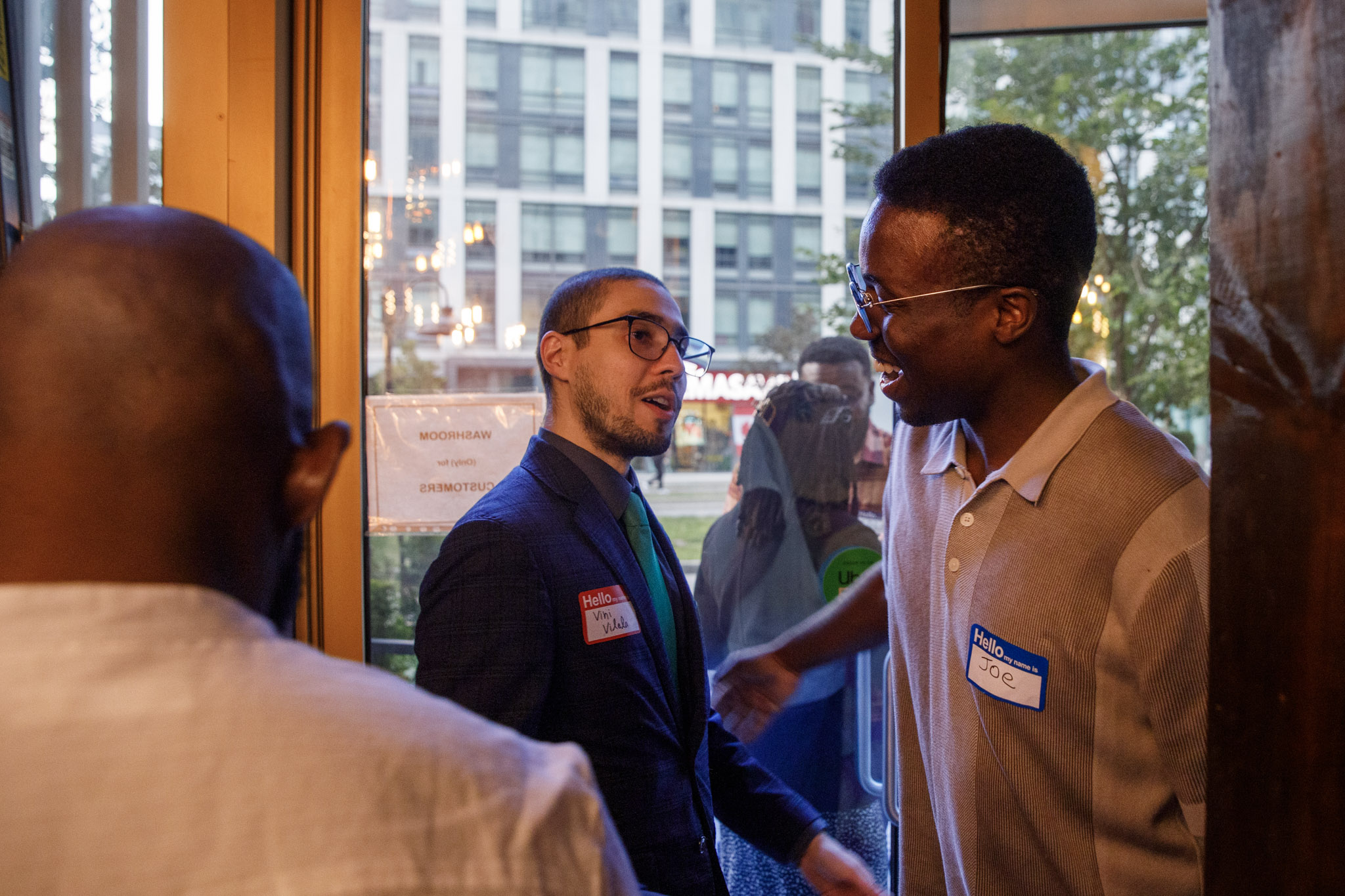
Networking games remove the stress of “what do I say?” or “who do I talk to?
- Creating space for more meaningful conversations and connections.`
Quick Answer
What Are the Best Networking Games for a Larger Group?
The best networking games for 100 - 500 people are the ones everyone can join easily, with simple instructions and gets people talking!
For Example:
- Facilitate Conversation Topics: best for real conversations · 10 - 20 min · no props
- Ha! (The Laughing Meditation): best as an energizer · 3 - 5 min · no props
- Jam Bingo: best for mixing people who don't know each other · 20 - 45 min · 100 - 500 people
- Four Corners: best for getting opinions out in the open · 10 - 15 min · four signs
- Line It Up: best for teamwork in small groups · 5 - 10 min · no props
- Speed Networking: best for fast introductions · 15 - 30 min · no props
- The French Counting Circle: best for group focus and team spirit · 5 - 10 min · no props
- Human Rock-Paper-Scissors Tournament: best as an energizer · 5 - 10 min · no props
- The Broken Telephone: best for laughs across language barriers · 10 min · no props
- The Korean 'Turning' Game: best as an energizer · 5 min · no props
1. Facilitate Conversation Topics
In a large group, you can direct people to network and connect with each other.
This concept is similar to Jam Bingo; however, an emcee or facilitator is directly involved, whereas Jam Bingo uses the app to facilitate the icebreaker.
For this:
The emcee will provide conversation topics, such as
- Ask someone what inspires them daily to keep going
and everyone in the room will have 60 seconds to find a group of 2 or 3 and discuss the topic. This encourages people to pair up and have meaningful conversations.
What to Watch Out For
Be mindful to give permission for people to find new groups for each conversation topic. People can sometimes stay with the same group for all the topics if you don’t guide them. Make sure the facilitator announces that everyone should form new groups for each conversation topic.
You can run as many conversation topics as needed to fill the time frame you’re aiming for.
2. Ha! (The Laughing Meditation)
This is a breathing and laughter game rooted in Indian Laughter Yoga principles, but adapted as a competitive-yet-silly icebreaker. It is designed to break down social barriers through forced, contagious eye contact and laughter.
How it works: Have everyone stand up and pair up. The rules are simple:
- Partners stand facing each other.
- They must maintain unbroken eye contact.
- On the count of three, they must let out a loud, serious, and dramatic 'Ha!' (Just one 'Ha,' not laughing yet).
- They take another breath. On the count of three, they let out a second 'Ha!'
- On the third breath, they let out a final 'Haaaaa!'—but this time, they are not allowed to stop. They must keep the 'Haaaaa' going until they run out of breath.
What happens? By the third round, maintaining eye contact while forcing a long 'Haaaaa' inevitably causes real laughter. Partners crack up, the sound spreads across the room, and soon 100 people are just genuinely laughing at each other.
It is physiologically impossible to feel anxious or shy while forcing laughter and maintaining eye contact. It requires zero preparation, no materials, and it immediately humanizes everyone in the room.
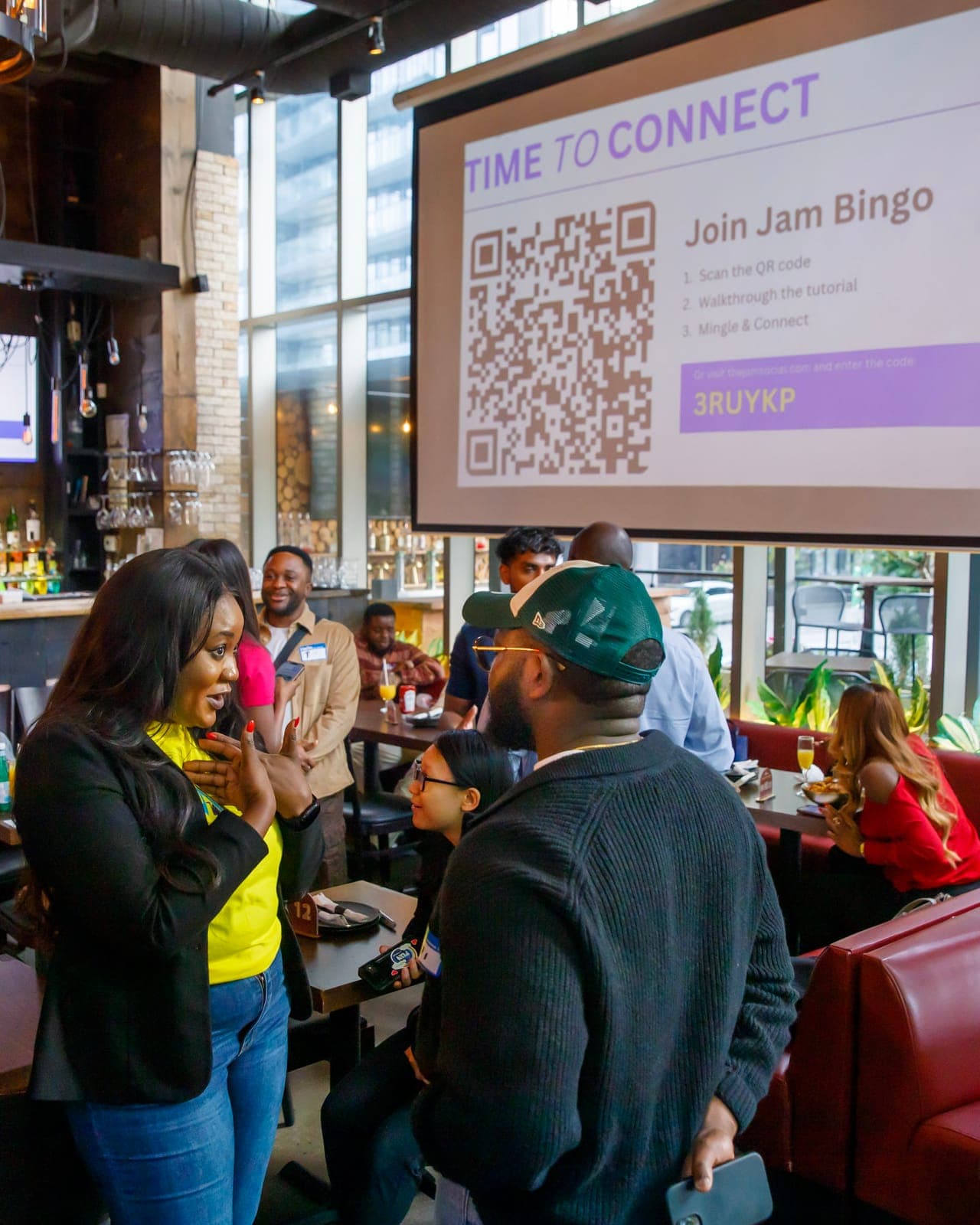
3. Jam Bingo; Easy Networking Game for 100-500 people
Get people out of their bubble and talking with colleagues and strangers who they don't know. Jam Bingo is an easy setup for a large group, and it incentivizes people to go talk to someone new.
What Jam Bingo does really well is alleviate the stress of networking. It gives people direction on:
- What to say
- and, who to say it to.
How does Jam Bingo work?
It gets people coming from different organizations or cities to talk and mingle with one another (so networking doesn't feel awkward or weird). See how Jam Bingo works!
4. Four Corners
Four Corners is a way to survey the crowd using This or That–type questions. The concept of this icebreaker is to make a statement, such as “Pineapple belongs on pizza,” and label four corners: Agree, Disagree, Strongly Agree, and Strongly Disagree.
Each corner can have a spokesperson to defend their position, whether they agree or disagree.
5. Line It Up
The Line It Up icebreaker may need to be divided into smaller groups depending on your group size. Get everyone to form groups of six.
Then, read out a prompt like 'Tallest to shortest' or 'Smallest to biggest shoe size.' Everyone in their groups must order themselves according to the prompt.
To make it more challenging, you can ask them to do it without talking or using hand signs.
This is by far one of the most fun and exciting icebreakers for a larger group.
6. Speed Networking
Structured one-on-one conversations happen in short bursts. Attendees form two lines facing each other and have 2 minutes to introduce themselves and answer a prompt, such as 'Share your favorite project you’ve worked on.' After 2 minutes, one line rotates to a new partner.
This is an efficient way to make multiple introductions in a short time.
7. The French Counting Circle
This is a classic French game typically played in camps or large gatherings. It’s a brilliant icebreaker because it requires intense eye contact and creates hilarious, dramatic tension over a very simple task.
How it works: Everyone stands in a large circle. The goal is to count from 1 to 10,000 (or just 20 for a quicker game) as a group. Anyone can start by saying 'Un.' The next person in the circle (randomly, not in order) says 'Deux.' If two people speak at the same time, the count resets to zero, and everyone groans. The game continues until the group successfully reaches the target number.
It forces 50+ people to pay intense attention to each other and read the room’s energy. The collective groans when the count resets build camaraderie, and the eventual success feels like a huge team victory.
Bonus Networking Ideas:
8. Human Rock-Paper-Scissors Tournament
This can be used as a fun icebreaker where people challenge others to a rock-paper-scissors match. The winner stays in the game, and the loser is out.
People walk around the room challenging each other until the group is reduced to just two players, and the final winner is crowned the tournament champion.
9. The Broken Telephone
'Broken Telephone' (or Chinese Whispers) is played globally, but the Latin American version, El Teléfono Descompuesto, often emphasizes funny physical actions or sound effects rather than just a single word, making it perfect for a large group.
How it works: Split the large group into 2–4 massive lines (depending on space). The person at the front of each line comes to the facilitator to see a simple phrase and an action (e.g., 'The chicken dances the salsa' while wiggling their tailbone). They tap the next person, perform the action, and whisper the phrase. The message is passed down the line via whispers and physical demonstration. The last person in line must perform what they saw and heard for everyone.
It’s a hilarious game of 'telephone' but adds a physical layer that translates across any language barriers within the group. Watching the message get distorted into a completely different animal and dance move by the end of the line is guaranteed to get huge laughs.
10. The Korean 'Turning' Game
This is a staple variety-show game in South Korea that tests focus and speed. It’s incredibly easy to set up and watch, but surprisingly difficult to play, creating a fun challenge for the whole room.
How it works: Have everyone stand up. The facilitator is the 'caller.' The rule is simple: Do the opposite of what I say.
- If the facilitator says 'Turn left,' everyone must turn right.
- If the facilitator says 'Turn right,' everyone must turn left.
- If the facilitator says 'Turn back' (face the rear), everyone must stand still.
- If the facilitator says 'Stand still,' everyone must turn back.
Anyone who messes up sits down. The game continues until only a few sharp people are left standing, who are then crowned the winners.
It requires active listening and coordination. For the first few rounds, 50+ people will bump into each other trying to turn the wrong way, leading to a lot of laughter and the gradual revelation of who in the room has the quickest reflexes.
Tips for Running an Icebreaker with 100 - 500 People
Use a microphone
Nobody at the back of the room can hear you otherwise.
Keep instructions simple
Explain the rules in one or two sentences. If it needs a long explanation, it's too complicated for a large group.
Demo it on stage
Demo it with 2 or 3 volunteers on stage before everyone starts.
Time-box every round
Time-box every round and announce when time is almost up.
Rotate partners
Tell people to find new partners each round, or they'll stay with the same group the whole time.
Let participants self-pair
Pick activities where people form their own pairs, so you don't have to split 300 people into groups by hand.
Not sure how long to plan for?
A quick energizer takes 5 - 10 minutes. A networking game, where people have real conversations, needs 20 - 45 minutes so everyone can meet several new people.
Frequently Asked Questions
What is the best ice breaker for a large group of 100 - 500 people?
For getting people to actually meet someone new, Facilitated Conversation Topics and Jam Bingo work best, because both send people to talk with someone they don't know. For a quick burst of energy, Ha! (The Laughing Meditation) and the Korean 'Turning' Game get the whole room laughing in under 5 minutes.
What are good large group energizers?
Large group energizers are short, active games that wake up the room. Ha! (The Laughing Meditation), the Korean 'Turning' Game, the Human Rock-Paper-Scissors Tournament, and Line It Up all take 5 - 10 minutes, need no props, and work with hundreds of people at once.
Which large group icebreakers for adults need no props?
Facilitated Conversation Topics, Ha! (The Laughing Meditation), Line It Up, Speed Networking, the French Counting Circle, the Human Rock-Paper-Scissors Tournament, and the Korean 'Turning' Game need no props at all. Four Corners only needs four signs, and Jam Bingo only needs attendees' phones and a QR code on the screen.
How long should a large group icebreaker take?
A quick energizer takes 5 - 10 minutes. A networking icebreaker, where people have real conversations, needs 20 - 45 minutes so everyone can meet several new people. Plan about 3 - 5 minutes per conversation.
How do you run an icebreaker with 500 people without it getting chaotic?
Use a microphone, explain the rules in one or two sentences, demo it with a couple of volunteers, and time-box every round. Pick activities that don't need you to split people into groups by hand, like Jam Bingo or Facilitated Conversation Topics, where people form their own pairs.
How do you get introverts to join a large group icebreaker?
Give them a clear reason to start a conversation and a script for what to say. Prompts like 'Ask someone what inspires them daily to keep going' remove the stress of 'what do I say?' and 'who do I talk to?', and pair or small-group formats feel much safer than speaking in front of the whole room.