
What makes a good icebreaker?
It starts conversations, not performances.
Before you pick an activity, it helps to know what you are actually looking for. A good corporate networking icebreaker has three things going for it.
First, it gives people a reason to approach someone they have never talked to. Not an obligation — a reason. There is a big difference. An obligation creates dread. A reason creates curiosity.
Second, it removes the burden of starting a conversation from scratch. When someone approaches you with a specific prompt or question, the opening line is already handled. Both people know why they are talking. That takes an enormous amount of pressure off.
Third, it scales. Something that works for 15 people in a boardroom is not the same as something that works for 150 people at a conference. Make sure the activity you choose fits your crowd size.
5 icebreakers for corporate events
Each one works for a different scenario — and draws from diverse cultural traditions.
Here are five corporate networking icebreakers worth knowing, when to use each one, and how they connect to practices from around the world.
1. 'Circle of Names' — for small teams (under 15)
Begin by sitting in a circle and saying their name along with a gesture, a sound, or a short praise phrase that represents them. Everyone else then repeats the name and the gesture. This continues around the circle, with each new person adding their own.
For a corporate setting, ask each person to say their name and one 'professional superpower' (e.g., 'I'm Jamie — I can explain anything with a whiteboard'). The group echoes it back. It is slow enough to be memorable, fast enough to finish in 10 minutes, and the physical repetition creates psychological safety.
It does not scale beyond 15 people, but for small teams it is more effective than two truths and a lie because nobody has to invent a fake story.
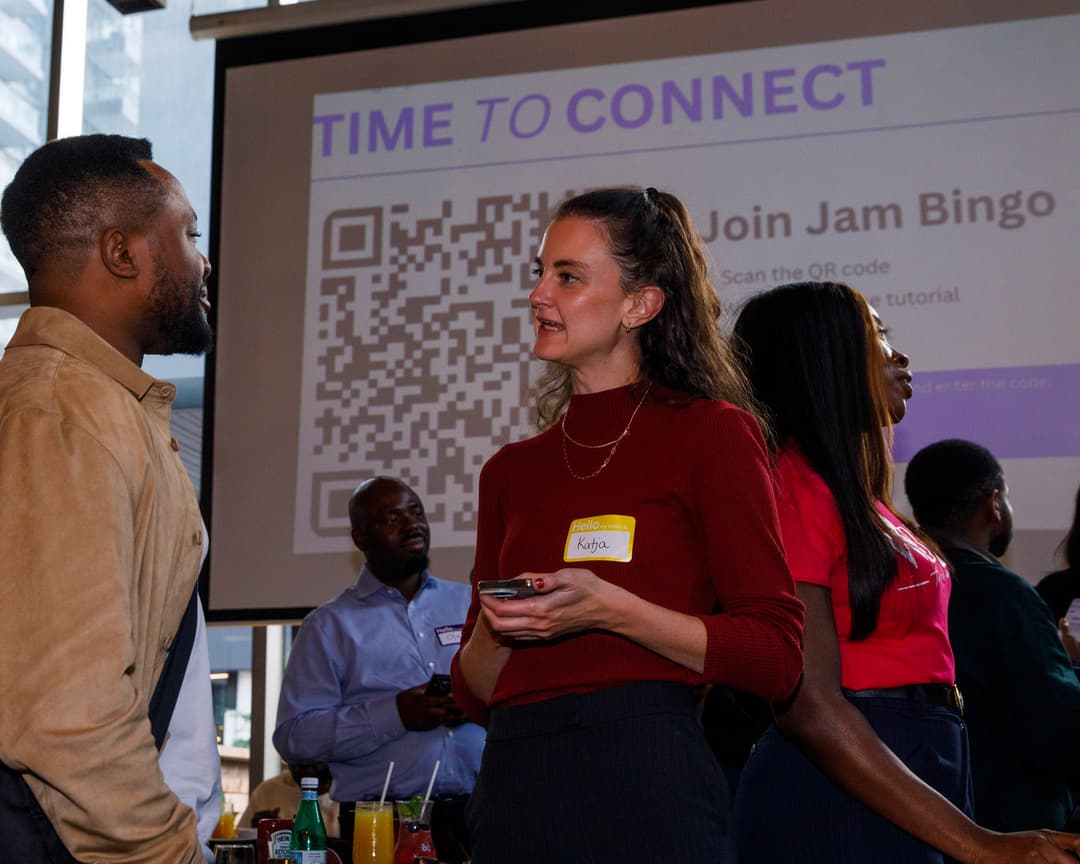
2. Jam Bingo App — for large groups of 100+
Jam Bingo is an interactive networking game by JamSocial designed for large groups of 100+ that gets attendees who don’t know each other talking, moving, and forming real connections through guided prompts and shared challenges.
3. Toast exercise — for global or hybrid teams
For an office setting, pair up attendees. Each pair takes three 'shared sips' of coffee, tea, or water.
After each sip, they answer one question:
- (1) something they admire about the other person's work
- (2) one challenge they are currently facing
- and (3) one way they could help each other.
Drinking together lowers defensiveness, and the three-question structure prevents awkward silences.
4. 'Talking Stick' — for seated dinners or workshops
Many Indigenous nations use a talking stick during council meetings: only the person holding the stick may speak, and everyone else listens without interrupting. The stick is passed around the circle.
For a corporate dinner or workshop, pass any object (a pen, a small trophy, a stone) around the table. Whoever holds it answers one question:
- 'What is one thing you wish your colleagues understood about your role?'
- No one may comment, ask follow-ups, or give advice until the object has gone full circle.
This is the opposite of speed networking — it creates deep listening. Use it when your team has unspoken friction or when new members need to be heard without being interrupted.
5. 'Fika' rotation — for conferences or all-day events
Fika is a deliberate coffee and pastry break with colleagues — not at your desk, but sitting down, often with someone new. It is a structured pause, not a rushed refill.
For a conference, schedule two 20-minute Fika breaks. At the first break, assign everyone a random partner to sit with for exactly 15 minutes.
Give them one prompt: 'What is the most interesting thing you are working on right now?'. At the second break, they rotate to a new partner. Unlike speed networking (which feels transactional), Fika feels human.
What about remote teams?
Digital icebreakers follow the same rules.
Remote and hybrid events have their own version of the awkward mingling window. It is the ten minutes before a call officially starts, where people join one by one and sit in silence watching the participant count go up.
A digital icebreaker fills that window the same way an in-person one does. A shared question in the chat. A quick poll. A prompt everyone answers before the meeting kicks off.
The goal is the same whether the event is in a hotel ballroom or a Zoom call: give people something to engage with before the formal agenda starts, so they arrive at the program already warmed up.
What makes corporate icebreakers fail?
Asking people to perform or overshare.
Most corporate icebreakers fail for one of three reasons.
- They are too personal. Nobody wants to share something vulnerable in front of fifty colleagues they barely know. Keep it professional and light.
- They put people on the spot. Anything that requires someone to speak in front of the group creates anxiety. Activities where people move and talk in pairs or small groups work much better.
- They take too long. Unelss you're running Jam Bingo App, a 30-minute icebreaker at a 60-minute event feels like it ate the whole thing. A good corporate networking activity takes 15 to 20 minutes and leaves people wanting more, not checking their watch.
The fix for all three is the same: give people a task instead of a prompt. Something to do. Something to find. Something to complete. When people are focused on the task, the conversation happens as a side effect — and that is exactly when it feels most natural.
Which icebreaker should you use?
Match the activity to your group size.
Here is a quick way to decide:
The best icebreaker is the one people do not realize is an icebreaker. When it is running well, it just feels like a good conversation.