
10 Interactive Networking Activity Ideas for Corporate Events
Simple, structured activities that get coworkers talking to people outside their usual team.

If you have ever planned a company event, you already know the pattern. People walk in, find the coworkers they already know, and stay right there for the rest of the night. Nobody is being rude. It is just easier to stand next to someone familiar than to walk up to a stranger with no reason to.
That is exactly the gap a structured networking activity is supposed to close. Instead of hoping people mingle on their own, you give them a reason to. Below are 10 simple ideas you can use at your next corporate event, from low tech classics to phone based networking gamification that scales to a few hundred people.
Quick answer: The easiest interactive networking activities for corporate events are ones that give people a specific reason to approach someone new, like QR code bingo, speed networking rounds, or team trivia. Phone based activities work best for large groups since they need no printed materials and no facilitator managing the room.
What is networking gamification?
It turns mingling into a game with a clear goal, not an open ended task.
Networking gamification just means adding game mechanics, like points, prompts, or challenges, to a networking session. Instead of telling a room full of employees to go mingle, you give them a specific task, such as finding someone who matches a prompt or answering a question with a new person.
The reason it works is simple. Most people are not bad at networking, they just do not want to be the one who walks up to a stranger for no clear reason. A game removes that awkward first step by giving everyone a built in excuse to talk.
Why does structure matter here?
Without it, people default to standing with whoever they already know.
Left alone, a networking break at a corporate event mostly benefits the people who are already comfortable working a room. Everyone else ends up on their phone, checking email, or talking to the one coworker they came in with.
A structured activity flips that. It gives quieter employees the same easy opening that outgoing employees create for themselves naturally, so the whole room actually mixes instead of just the confident half of it.
1. QR code bingo
No printing, no pens, everyone joins from their own phone.
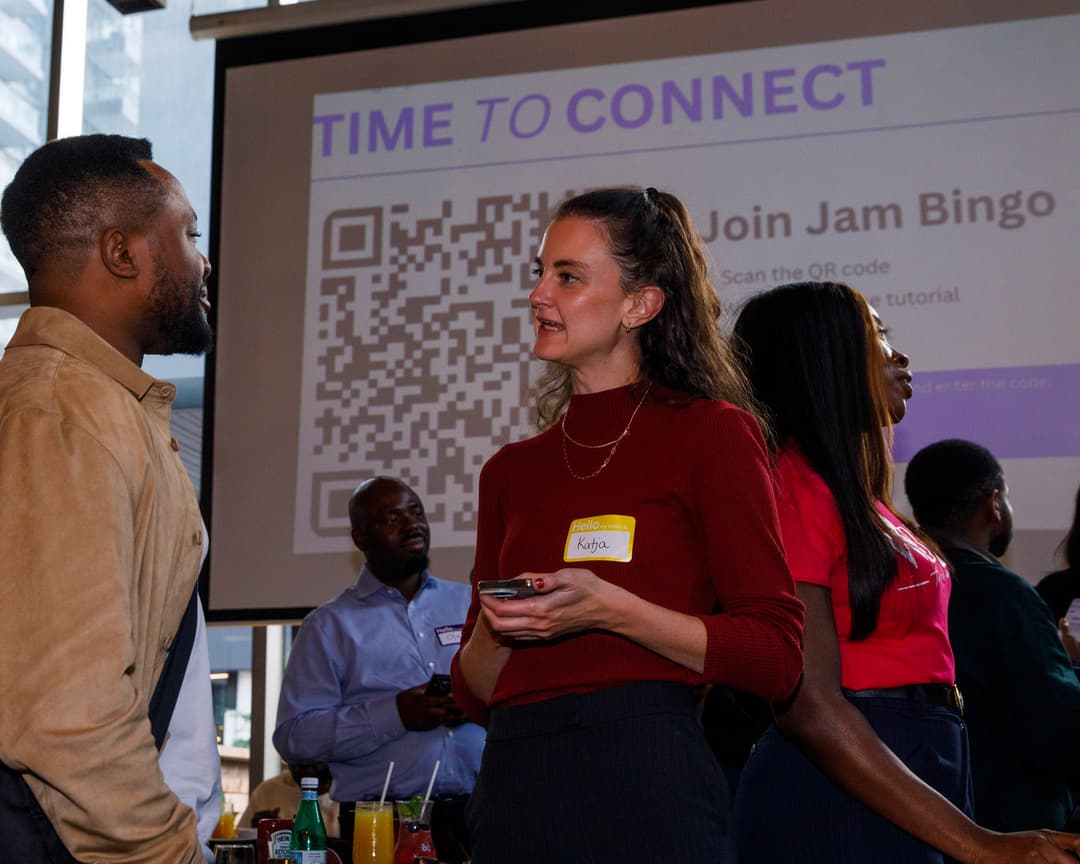
- Jam Bingo: For groups of 100+ people, encourage staff members to connect with others from different departments and/or cities.
This is ideal for large group sizes because there is nothing to hand out and nothing to run out of. See how Jam Bingo works!
2. Speed networking rounds
Short, timed one on one conversations, then rotate.
Pair people up for two or three minutes, then have everyone rotate to a new partner. It works well right before a session starts, since the time limit keeps things moving and nobody has to figure out how to end a conversation gracefully.
3. Team trivia
Mix departments into small trivia teams instead of letting people self select.
Trivia is an easy sell because most people already like it. The trick is assigning teams instead of letting employees pick their own, which is what actually forces cross department mixing rather than the usual cliques.
4. A phone based scavenger hunt
Small tasks around the venue that require finding a coworker to complete.
Build a short list of tasks, like take a photo with someone from another office, or find someone who has worked at the company longer than five years. It works especially well at offsites where people have room to actually walk around.
5. Two truths and a swap
A twist on the classic that forces people to move between groups.
Everyone shares two truths and a lie in a small group, then one person from each group rotates to a new one. It keeps the classic format but adds enough structure that groups do not just stay static for the whole session.
6. Live polling questions
Fun, low stakes polls that spark conversation right after.
Run a quick live poll on a screen, like which team has the best office snacks, then give people a minute to find someone who voted differently and ask why. The poll itself takes seconds, and the conversation that follows is the real point.
7. Conversation card stations
Set up a few stations, each with a different prompt card.
Place a handful of tables or stations around the room, each with a different conversation prompt taped to it. People naturally cluster and rotate through stations over the course of the event, without anyone having to manage a schedule.
8. Skill swap speed rounds
Employees pair up to trade one useful skill or tip each.
Pair employees for five minutes and have each person teach the other one small, useful skill, like a keyboard shortcut or a quick negotiation tip. It gives the conversation a clear purpose beyond small talk, which makes it easier for quieter employees to join in.
9. A departmental bingo
Prompts built specifically around your teams, not generic small talk.
- Find someone from a department you have never worked with.
- Find someone who joined the company in the last six months.
- Find someone who works in a different office or timezone.
- Find someone working on a project outside your own team.
Prompts tied to your actual company always outperform generic ones, since they push people toward someone specific rather than just anyone nearby.
10. A guided mingle window
One dedicated block of time, announced clearly, before the main program starts.
Sometimes the simplest fix is giving networking its own labeled time slot instead of squeezing it in between agenda items. Announce it clearly, put the activity instructions on the big screen, and let people know exactly how long they have.
How do you pick the right one?
Match the activity to your group size and venue.
For a small team of 10 to 20, low tech options like two truths and a swap or conversation card stations work fine. Once you are past 50 or 100 people, phone based interactive networking activities tend to work better, since they do not depend on a facilitator reaching every single person.
FAQ
How long should a networking activity run at a corporate event?
Fifteen to twenty minutes is usually enough. Long enough for people to have a few real conversations, short enough that it does not eat into the rest of the agenda.
Do these activities work for a hybrid or remote team?
The ones on this list are built for in person events specifically, since the goal is getting people physically talking face to face. For remote or hybrid teams, look for activities designed around video calls instead.
What if some employees do not want to participate?
That is normal, and it is fine. Make participation easy and low pressure rather than mandatory. Most people join once they see a few coworkers already doing it.
Do I need an app for interactive networking activities?
Not always. Low tech options like trivia or conversation cards need no app at all. For larger groups, a simple QR code based activity is usually easier than installing anything, since employees just scan and go.
How much does an activity like this cost to run?
Low tech options like trivia or card stations can be nearly free, aside from your own time to prep them. Phone based tools usually charge per event, but save you the cost and hassle of printing materials.