
Networking Bingo vs. Trivia vs. Scavenger Hunt
Three formats that all promise the same thing: get people out of their bubble and talking.
If you're planning an event and searching for an icebreaker, you've probably run into the same three options over and over. Networking bingo, trivia, and scavenger hunts all show up on every list of icebreaker ideas, and they all get pitched as the fix for a quiet room full of strangers.
But they don't actually do the same job. Trivia tests what people know. A scavenger hunt tests what people can find. Networking bingo is the only one of the three built specifically around getting two strangers to stand in front of each other and talk.
That difference matters a lot depending on what you're actually trying to accomplish, so let's break down how each one performs.
What is each format actually testing?
Bingo tests connection. Trivia tests knowledge. A scavenger hunt tests speed.
Networking bingo hands each attendee a card of prompts like find someone who has traveled to three continents. The only way to fill a square is to walk up to a stranger and start a conversation.
Trivia asks people to recall facts, usually in small pre-formed teams. It's fun, but the format rewards people who already know each other and already sit together, since teammates lean on whoever knows the most.
A scavenger hunt sends people off to find objects, locations, or complete small tasks around a venue. It's active and it gets people moving, but most of the energy goes toward finding things, not toward talking to anyone in particular.
Which format works for a big crowd?
Bingo and trivia scale easily. Scavenger hunts get harder to manage past a certain size.
Trivia scales well because it's usually run from a stage with a host, a screen, and teams answering on their phones or on paper. A scavenger hunt gets trickier once a group gets into the hundreds, since you need enough physical space, enough objects or stations, and usually some staff on hand to keep things from turning into chaos.

Networking bingo scales differently, because every attendee is running their own card at their own pace. There's no waiting for a host to read the next trivia question and no bottleneck at a scavenger hunt station. A room of 300 can start at the exact same moment a room of 15 can.
Which one actually builds new connections?
Bingo is the only format built around meeting someone specific.
Trivia teams tend to be assigned or self-selected, which usually means people end up next to the same coworkers or friends they came in with. A scavenger hunt often works the same way, since most people team up with whoever they walked in with, which means the format rarely forces anyone outside their existing group.
Networking bingo flips that. Every prompt is written to send someone toward a stranger, not a teammate. Prompts like find someone from a department you've never worked with are designed to break up existing cliques instead of reinforcing them.

Which format takes the least prep?
Trivia and scavenger hunts usually need more planning than a QR code bingo card.
Trivia needs a question bank, a host, a way to score teams, and usually some kind of prize structure. A scavenger hunt needs a list of items or tasks, a plan for the physical space, and often staff to check people off as they finish.
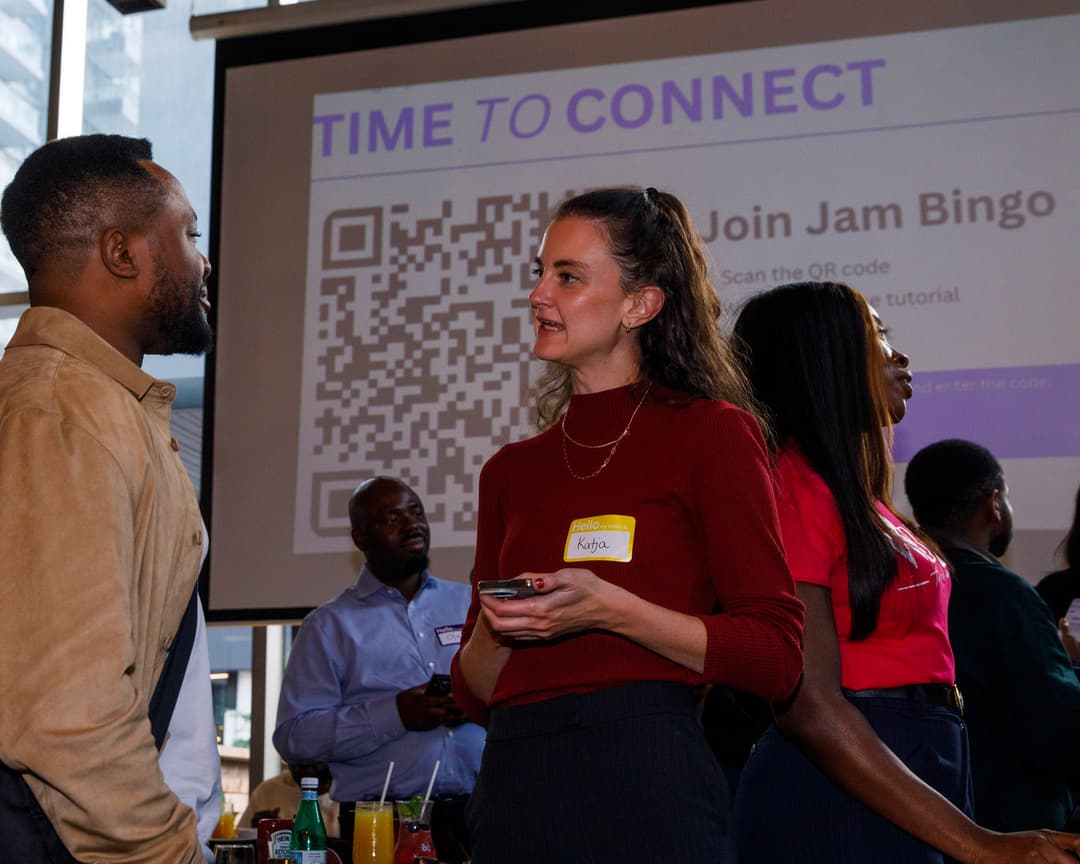
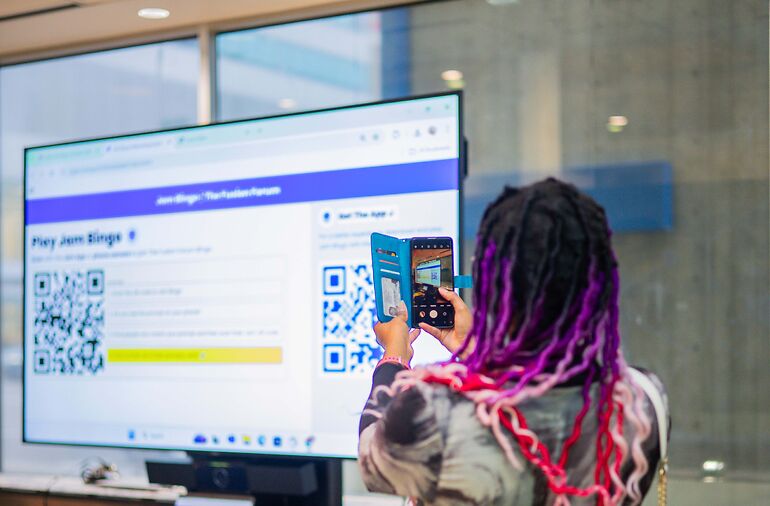
A digital networking bingo card, like Jam Bingo, skips most of that. There's no printing, no pens, and no facilitator needed to keep the game moving. Attendees scan a QR code and the prompts are already loaded.
Does depth of conversation matter?
Bingo prompts push toward real conversation, not just a checkbox.
A trivia answer is usually a fact, shouted out or typed in, and the conversation ends there. A scavenger hunt task is often just as short: find the item, snap a photo, move on to the next one.
A good bingo prompt asks something that requires an actual back and forth, like find someone who started at the company this year or find someone who has run a marathon. Filling the square means learning something real about the other person, not just confirming a fact.
What about competitive energy?
All three can be competitive, but only bingo channels that energy into meeting people.

Trivia and scavenger hunts both tend to bring out competitive energy focused on winning, which is fun, but it's competition aimed at points or prizes, not at people.
Bingo keeps a bit of that same competitive pull, since people still want to be the first to fill their card, but the only way to win is by talking to more people. The competition and the networking goal point in the same direction instead of pulling against each other.
So which one should you actually pick?
It depends on your goal, but for pure networking, bingo is built for the job.
If your goal is entertainment and team bonding among people who already know each other, trivia is a solid pick. If you want people up and moving around a venue, a scavenger hunt adds energy.
But if your actual goal is getting strangers to talk to strangers, whether that's at a conference, an all company meeting, or a student orientation, networking bingo is the format that was built specifically for that job.
Frequently Asked Questions
Can trivia and networking bingo be combined at the same event?
Yes. A lot of events run bingo during the mingling window before the program starts, then move into trivia once everyone is seated. Bingo handles the networking goal early, and trivia adds a fun, competitive moment later without competing for the same time slot.
Is a scavenger hunt better for outdoor events?
Scavenger hunts do tend to work well outdoors or across a large venue with multiple stations, since the format is built around physical movement through a space. Networking bingo can also work outdoors, but it doesn't require a large physical footprint the way a hunt does.
Networking Bingo for 100+ people?
Jam Bingo is a networking bingo platform designed for large groups. It is ideal for events looking to get people having meaningful conversations instead of surface-level networking.
Does networking bingo require an app download?
No, with a tool like Jam Bingo, attendees just scan a QR code from their phone's camera and the game loads in a browser. There's nothing to install and nothing to remove afterward.
Which format is easiest for a shy or introverted crowd?
Networking bingo tends to work best here, because the prompt itself gives an introvert a built-in reason to approach someone. Trivia can actually be harder for quieter attendees, since it often rewards whoever speaks up fastest within a team.
How long should any of these activities run?
Most events give any of these formats 15 to 20 minutes. That's usually enough time for attendees to complete several bingo squares, answer a handful of trivia rounds, or work through a shortened scavenger hunt list without cutting into the main program.
Did this blog help?
Were you instead looking for:
Ice breaker for a large group (100+ people)
In summary:
Learn more at @thejamsocial.